
From the air, Hersham Works appears almost to be a town within a village.
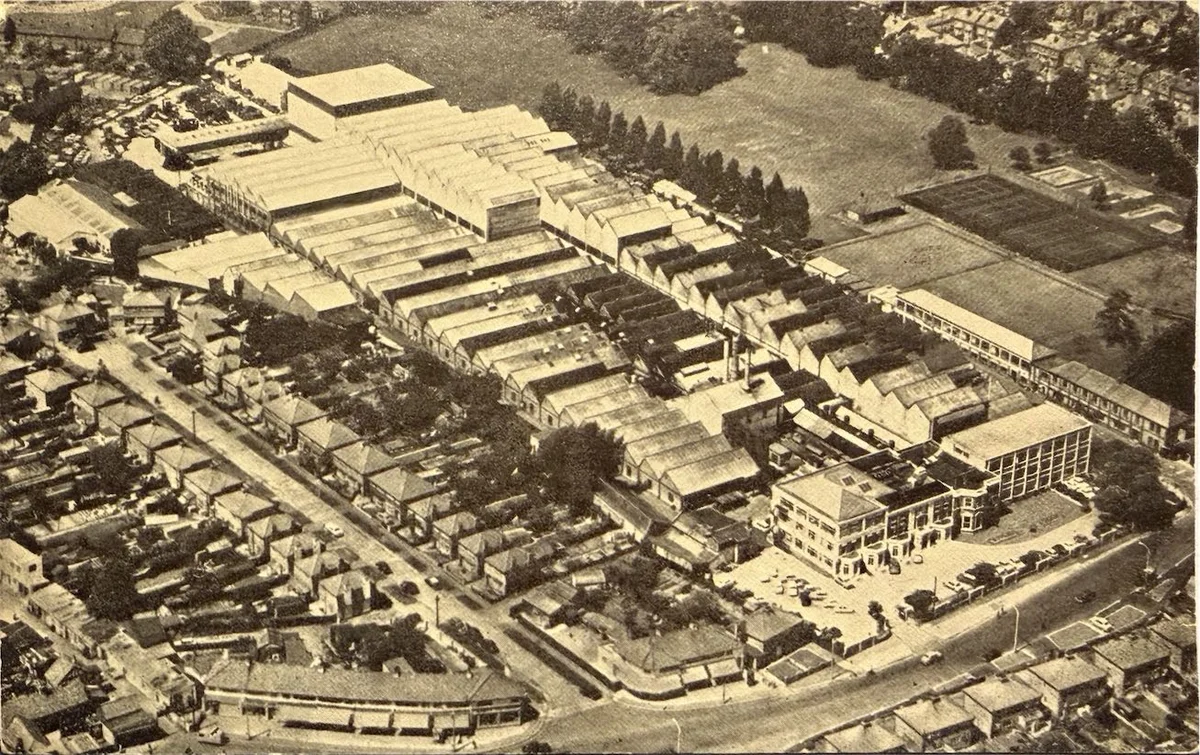
An old company postcard shows ranks of factory roofs spreading back from Molesey Road, workshops and offices crowded together behind the frontage, with the open ground that survives today as Hersham Recreation Ground beyond them. There’s little in the photograph to suggest that this industrial landscape had grown from the grounds of one of Hersham’s substantial private houses.
Almost everything visible in it has since disappeared. The factories were swept away in the late 1970s as the site entered a new life associated with Air Products. The offices and research buildings that replaced them are now themselves expected to disappear if the latest redevelopment proceeds: Elmbridge’s Planning Committee considered plans for hundreds of homes on the site in March 2026, almost exactly half a century after an earlier generation had also contemplated turning the land over to housing.
Few sites in Hersham capture the changing character of the village quite so neatly. Within the boundaries of today’s Hersham Place Technology Park can be traced a transition from country-house estate to motor engineering, electrical manufacturing, corporate offices and, potentially, back to residential use. At the centre of the earliest part of that story was Hersham Lodge.
Before the factories
The origins of Hersham Lodge are more complicated than they first appear. Historical material prepared for Berkeley’s redevelopment describes an eighteenth-century house called Hersham Place, which it says was superseded by Hersham Lodge, presenting the Lodge as a nineteenth-century development occupying about seven acres of garden and parkland, with the house standing towards the eastern side of the site and facing Molesey Road.
There’s an important piece of evidence that pushes the name Hersham Lodge further back than that simple chronology might suggest. Surrey History Centre holds a watercolour by John Harrison Scott entitled Hersham Lodge, the Seat of J Scott Esq near Esher in Surrey taken from the River Mole, dated to about 1820. That doesn’t yet tell us precisely when the house was built, or whether the Hersham Lodge shown around 1820 was identical to the later Victorian house, an earlier building later remodelled, or a renamed version of Hersham Place. It does establish that a residence called Hersham Lodge was already part of the local landscape by the early nineteenth century, so the safest interpretation is that the estate evolved over time rather than assuming a neat, single-date replacement of Hersham Place by a completely new Hersham Lodge.
By the later nineteenth century the house was certainly substantial. Berkeley’s own heritage research for the site states that Henry Brooks acquired Hersham Lodge in about 1887 and enlarged it, describing it as the largest house in the village; Brooks and his wife remained associated with the property until their deaths in 1917. Within little more than a year, the character of the estate began to change completely.
ABC arrives at Hersham Lodge
In August 1918, while the First World War was still being fought, Walton Motors Ltd acquired Hersham Lodge on Molesey Road. Walton Motors had been formed in 1917 as a subsidiary associated with ABC’s work on government aero-engine contracts (see our full history of ABC Motors in Hersham). Historian D. A. Hales, whose reconstruction draws on surviving ABC company minutes, records that the seven-acre Hersham Lodge property offered something the existing works couldn’t easily provide: room for substantial expansion.
This distinction between the two sites matters. ABC already had works in Hersham; Hersham Lodge wasn’t simply another name for the company’s original factory. The Lodge estate became a newer expansion on the opposite side of the company’s existing industrial operation, and confusing the two obscures an important part of Hersham’s industrial geography.
The mansion itself offered office accommodation; its grounds offered space for machinery, workshops and production. ABC’s surviving minutes record £9,000 for factory extensions in March 1919, which Hales considers likely to have been behind Hersham Lodge. The evidence becomes clearer the following year: when ABC was reorganised as ABC Motors (1920) Ltd, a new factory was built at Hersham with modern machinery and production methods, and Hersham Lodge was unquestionably part of the company’s operations by then. A surviving photograph even shows the house during the ABC period with a Bean car standing outside.
The ambitions were considerable. ABC hoped to turn wartime engineering experience into large-scale peacetime production, and its light car, developed around an air-cooled flat-twin engine associated with the inventive engineer Granville Bradshaw, attracted real attention. By March 1920 agreements involving Harper Bean and the British Motor Trading Corporation contemplated production on a scale ABC would never successfully achieve.
Hersham Lodge therefore witnessed a remarkable transition: a private residence and its gardens became part of an attempt to establish modern mass motor production in the years immediately after the First World War. It didn’t last. ABC’s ambitious expansion ran into serious financial difficulties, and the new factory associated with the Hersham Lodge estate subsequently passed to another engineering business, the Hackbridge Company. Cars were about to give way to transformers and electrical equipment.
The factory that swallowed the estate
Hackbridge produced electrical transformers and cables. The Hewittic Electric Company, a manufacturer of mercury-arc rectifiers, subsequently combined with Hackbridge’s transformer business, and the combined Hackbridge & Hewittic Electric Co. Ltd. name was in use by the late 1940s. Surrey History Centre’s collections underline how significant the operation became: archive reference SHC 6740 contains a 1928 Hewittic tender and related material, while SHC 9080 preserves records associated with Hackbridge & Hewittic at Hersham, both promising sources for a future expansion of this article.
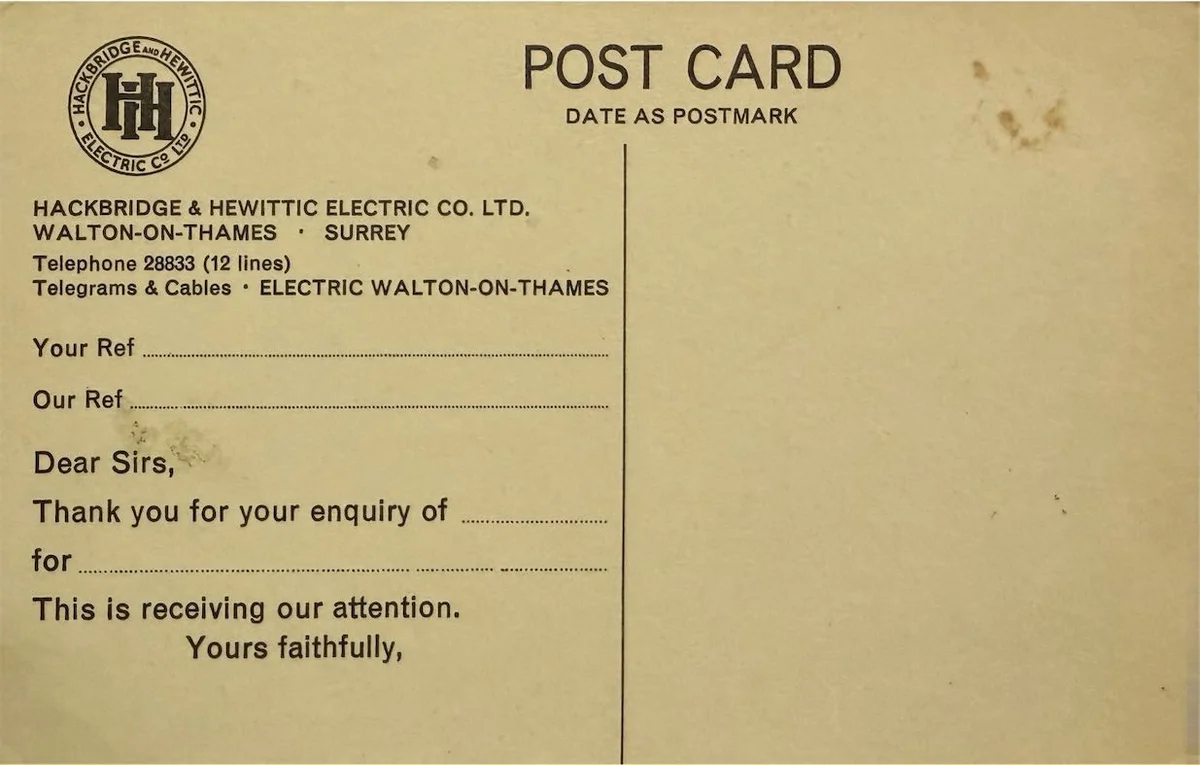
The physical transformation of the site can already be followed through planning records. What had begun as a factory inserted into the grounds of Hersham Lodge grew steadily into a dense industrial complex, and Elmbridge’s historical planning database records successive additions including factory extensions, test houses, stores, a transformer house, paint facilities, a millwright’s shop, crane storage, expanded offices and buildings for experimental and research work. Berkeley’s historical study for the site summarises the scale of that expansion by saying Hersham Works was enlarged repeatedly between 1925 and 1956, growing to more than four times its earlier size, and describes Hersham Lodge itself as having become subsumed within the complex.
There’s perhaps no better evidence of that transformation than the photographs taken from the air on 13 July 1950. Aerofilms made a sequence of images catalogued as the Hackbridge and Hewittic Electric Co Works, Hersham, held today by Britain from Above, showing a tightly packed industrial site covering much of the former estate, with long factory roofs extending across the land behind the Molesey Road frontage. By then the story of the site was no longer chiefly visible in the house from which it had grown; Hersham Lodge had become a fragment within something far larger. The factory had effectively swallowed the estate.
Housing, first time around
The present proposal to build homes at Hersham Place can look like a consequence of twenty-first-century changes in office working. In fact, the idea is more than half a century old. Elmbridge’s planning archive records application WAL/1973/0388, which proposed estate roads and access together with 54 flats and 80 houses on the Hersham Place site. Even more striking is application WAL/1973/0674, which sought permission simply for “development for residential purposes.” Permission was granted on 19 April 1974.
The significance is easy to miss: more than fifty years before the current Berkeley proposals, residential redevelopment of this industrial land had already passed beyond speculation and received planning permission. Yet the houses weren’t built, and a very different future emerged instead. Why the permitted residential scheme was abandoned remains one of the more interesting unanswered questions in the site’s history, one the surviving application files may eventually help settle. For now, the planning record establishes the curious historical echo: Hersham Place came close to becoming housing in the 1970s, only for that idea to return half a century later.
1977: preparing to erase Hersham Works
By the middle of the 1970s, the industrial landscape was approaching its end. The planning history records a decisive change in 1977: application 1977/0087 proposed 120,000 square feet of new industrial and research accommodation together with a canteen, explicitly following demolition of the existing buildings, while another application that year sought a three-storey, 30,000-square-foot office block. Air Products was already part of the transition, with application 1977/0088 seeking a waiver of existing office occupancy conditions specifically in favour of Air Products Ltd of New Malden.
Hales records that Hersham Lodge and the adjacent factory buildings were demolished in 1978, an account that fits closely with the contemporary planning evidence for wholesale demolition and redevelopment. It was an extraordinary moment in the site’s history: the early nineteenth-century name had survived, but the physical Hersham Lodge hadn’t, and neither had the industrial complex that had grown around it.
The Air Products era
The redevelopment produced the next recognisable version of the site. Air Products established major office and research operations there, and subsequent planning applications show the campus continuing to evolve, including further office accommodation and parking during the 1980s. For another generation, this was the identity of the land beside Molesey Road: the heavy industrial works had vanished beneath a corporate campus of offices, research facilities, landscaped areas and extensive surface parking, a contrast with the Hackbridge & Hewittic era that could hardly have been greater.
Yet this incarnation, too, proved temporary. Air Products ultimately decided to leave Hersham, and the company’s 2025 financial accounts record the final transaction with unusual precision: in June 2025, Air Products sold its regional office in Hersham for $37.7 million in cash, recognising a pre-tax gain of $31.3 million. Another long chapter had closed.
Hersham Place returns to housing
By then, plans were already forming for another comprehensive redevelopment. Berkeley began public consultation over the future of Hersham Place Technology Park during 2025, while Elmbridge Borough Council considered whether adjoining council-owned land beside Queensway should be incorporated into the wider proposals. The scheme changed as consultation progressed: in June 2025 the emerging masterplan contemplated approximately 300 homes, and by the final consultation in September this had been reduced to about 280 homes, with buildings generally between two and five storeys, a central green space, improved pedestrian and cycle connections, and an indicative location for a new GP practice.
The names chosen for the proposed neighbourhood reveal an unusual degree of historical consciousness. The September masterplan included Hersham Lodge, Lodge Green, Lodge Approach, Lodge Lane and Air Avenue, borrowing directly from past occupants of the land for the vocabulary of its proposed future.
The formal hybrid planning application, 2025/2530, was received by Elmbridge on 2 October 2025 and validated on 14 October, proposing residential development, flexible commercial uses, a new vehicular access to Queensway, landscaping and associated works following demolition of the existing buildings, wording with an unmistakable historical resonance: almost fifty years earlier, planners had considered another application describing the demolition of the buildings then occupying this same ground. Hersham Place was preparing to erase itself again.
262 homes and a decision not quite complete
By the time application 2025/2530 reached Elmbridge’s Planning Committee on 10 March 2026, the scheme had been reported as providing 262 homes rather than the roughly 280 shown during the final public consultation, and councillors supported the redevelopment, subject to a legal agreement covering matters including affordable housing, infrastructure and environmental mitigation.
The distinction between a committee resolution and a completed planning permission matters. Elmbridge’s own planning portal could not be checked directly for this article, so the current, formal decision status hasn’t been independently confirmed here; the most accurate description at the time of writing is that the council’s Planning Committee resolved to support the redevelopment on 10 March 2026, with a legal agreement still required before a final decision notice could follow. That status may change, and the history of this particular site suggests nothing should be treated as inevitable until it actually happens.
The place beneath the buildings
Look again at the Hackbridge & Hewittic postcard and almost none of today’s Hersham Place is recognisable. Look at Hersham Place Technology Park today and almost nothing in the postcard remains. That’s what makes this otherwise unassuming piece of land so revealing.
Its history isn’t simply a succession of company names. It records changes far beyond Hersham itself: the retreat of the country-house estate, the extraordinary confidence of British motor and aero engineering after the First World War, the growth of electrical manufacturing and research, the replacement of heavy industry by landscaped corporate offices, and then the declining need for large suburban office campuses and the pressure to turn brownfield employment land into housing. Each phase has overwritten the one before it. Hersham Lodge survived the first industrial incursion because ABC adapted it as offices, then became increasingly engulfed by the factory around it before finally disappearing in the late 1970s; Hackbridge & Hewittic’s workshops followed it into memory; Air Products’ buildings took their place, and now they too face demolition.
Yet something has proved surprisingly resilient: the name. Around 1820, John Harrison Scott called his subject Hersham Lodge. Two centuries later, Berkeley has proposed returning that name to the Molesey Road frontage, alongside Lodge Green and Lodge Lane, and the wider site still carries the name Hersham Place, linking its possible twenty-first-century future with a much older landscape. Buildings have lasted decades. The place has lasted centuries.
Open questions for further research
- What is the precise architectural relationship between the eighteenth-century Hersham Place described in Berkeley’s material and the Hersham Lodge shown in the c.1820 Scott watercolour: the same house renamed, or a genuine replacement?
- Why was the 1974 residential permission for Hersham Place (WAL/1973/0674) never implemented?
- What do the Surrey History Centre archives SHC 6740 and SHC 9080 reveal about Hackbridge & Hewittic’s operations at Hersham in more detail, including the precise merger history involving English Electric and GEC?
- Has a final decision notice now been issued for application 2025/2530, and if so, on what date and with what conditions?
We’ll update this page as the redevelopment progresses and as further primary sources come to light.
Sources
- Surrey History Centre (c.1820) 'John Harrison Scott, Hersham Lodge, the seat of J Scott Esq near Esher in Surrey taken from the River Mole, ref 4220/1 p.54'. Available at: https://www.exploringsurreyspast.org.uk/ ↗ (Accessed: 2 August 2026).
- Hales, D. A. (n.d.) 'The development of, and my interest in, the ABC Light Car, ABC Road Motors'. Available at: https://abcroadmotors.co.uk/articles/features-history/20-the-development-of-and-my-interest-in-the-abc-light-car.html ↗ (Accessed: 2 August 2026).
- Hackbridge and Hewittic Electric Co (n.d.) 'Company history and references'. Available at: http://www.hackbridgeandhewittic.co.uk/references/index.htm ↗ (Accessed: 2 August 2026).
- Britain from Above (1950) 'Hackbridge and Hewittic Electric Co Works, Hersham (EAW030963-EAW030967), 13 July 1950'. Available at: https://www.britainfromabove.org.uk/en/image/EAW030964 ↗ (Accessed: 2 August 2026).
- Elmbridge Borough Council (n.d.) 'Planning history for Hersham Place Technology Park, Molesey Road, application 2025/2530'. Available at: https://emaps.elmbridge.gov.uk/ebc_planning.aspx?Filter=%5EAPPLICATION_NUMBER%5E%3D%272025%2F2530%27 ↗ (Accessed: 2 August 2026).
- Elmbridge Borough Council (2025) 'Shaping Hersham update'. Available at: https://www.elmbridge.gov.uk/news/2025/shaping-hersham-update ↗ (Accessed: 2 August 2026).
- Berkeley Group (2025) 'Hersham Place public consultation'. Available at: https://hershamplaceconsultation.co.uk/ ↗ (Accessed: 2 August 2026).
- Air Products and Chemicals, Inc. (2025) 'Form 10-K for the fiscal year ended 30 September 2025'. Available at: https://www.sec.gov/Archives/edgar/data/2969/000000296925000055/apd-20250930.htm ↗ (Accessed: 2 August 2026).