
In the spring of 1649, only weeks after the execution of Charles I, a small group of men from Cobham walked onto St George's Hill and began digging. They planted parsnips, carrots and beans on waste land that they believed should sustain everyone rather than enrich a few. Their experiment lasted barely a year, but it drew in Walton commoners, soldiers, magistrates, clergy, lawyers, parliamentarians, families, pamphleteers and landowners. It also produced some of the most radical political and religious writing of the English Revolution. This article reconstructs the Diggers in their actual local landscape, from Walton-on-Thames and St Mary's Church to Little Heath in Cobham, and separates what the evidence establishes from what later retellings have simplified or mythologised.
Contents
- Who were they? A small community that from April 1649 cultivated common and waste land in Surrey, arguing that the earth had been created as a “common treasury” for all. The first diggers reported were Cobham men; Gerrard Winstanley quickly became the movement’s chief writer. Read more
- Where were the two Surrey settlements? First on St George’s Hill, which the Diggers themselves placed in the parish of Walton; then, by 24 August 1649, on Little Heath in Cobham. Read more
- Why does Walton matter? Walton men reported them, opposed them and attacked them, Diggers were held in St Mary’s Church, and the litigation arose from the common-land world of the Manor of Walton. Read more
- What did “common” land mean? Not ownerless land. Manorial land could carry customary rights for particular tenants or inhabitants, such as grazing animals or gathering fuel. Read more
- Why did local people disagree? The Diggers’ universal claim to the earth could threaten people who held modest but real customary rights of their own. Read more
- When did it end? On 19 April 1650 six houses at Little Heath were burned, ending the permanent Surrey settlement. Read more
- Where exactly did they dig? Nobody knows precisely. The first plot lay “next to Campe Close”, which has not been securely identified; the hillfort and Camp End Road landscape is the strongest general candidate, not a proven site. Read more
Beginnings on St George’s Hill
A few men with spades
In the first days of April 1649, five men went to St George’s Hill in Surrey and began to dig. Henry Sanders, a Walton-on-Thames yeoman who reported their activities to the new republican government, named William Everard, a man he called “Stewer”, another called “Colten”, and two unnamed companions. All five, he said, were living at Cobham. They worked ground on the side of the hill “next to Campe Close” and sowed parsnips, carrots and beans. The following day their numbers increased. On the next they burned part of the heath to prepare more land. By the end of the week Sanders reckoned that between twenty and thirty people had spent a day digging, with plans to bring ploughs and seed corn obtained at Kingston (Firth, 1894, pp. 194–195; Gurney, 2007).
The exact starting date is uncertain. Gerrard Winstanley later remembered 1 April as the beginning of the action, and that date became the traditional one. Yet Sanders’s contemporary chronology can also be read as pointing to Sunday 8 April. Ariel Hessayon therefore concludes that the first digging occurred on 1 or 8 April and that certainty is impossible based upon the surviving evidence (Hessayon, 2008; Hessayon, 2014).
One point is not uncertain, the Diggers themselves described the site as “George-Hill, in the Parish of Walton, in the County of Surrey” (Everard et al., 1649/2009). Modern St George’s Hill is normally associated with Weybridge, but in 1649 the first plantation belonged to Walton-on-Thames. That fact is essential to understanding what followed.
The popular story often begins with Winstanley leading a band of poor men onto the hill. The earliest report is more complicated. Winstanley is not one of the first five men named by Sanders, Everard is. “Stewer” and “Colten” can be identified with reasonable confidence as Thomas Starr and John Coulton, both Cobham men who subsequently signed Digger declarations and remained closely involved. By 19 April Captain John Gladman described Winstanley and Everard together as the “chief men” who had persuaded the others, but the precise moment at which Winstanley joined the digging is unresolved (Firth, 1894, p. 196; Gurney, 2007; Hessayon, 2008).
The Surrey Digger movement was not simply one man’s idea acted out by followers. It emerged from a local network, and the first people in the documentary record were Cobham inhabitants crossing onto common land belonging to Walton.
Why Walton matters
The Digger story is frequently presented as the history of “St George’s Hill, Weybridge”. That is understandable in modern geographical terms, but it obscures the seventeenth-century setting.
The ancient parish of Walton-on-Thames was much larger than today’s town. It included Hersham and much of Oatlands, and its common and waste lands extended southwards towards Cobham. Irene Sandells’s map of the ancient parish makes this scale particularly clear. It shows Walton reaching far beyond the later urban centre and helps explain why contemporary writers located George Hill within Walton (Sandells, 1992). Sandells’s map is useful as local historical orientation, though she herself cautioned that her church history was written for the general reader and that not every claim had been checked against original records (Sandells, 1992).
St George’s Hill formed part of a complicated landscape of manor, common, heath and waste. The commons associated with Walton and Walton Leigh were not a blank public space that anybody could simply occupy. “Common” did not mean ownerless. Manorial land could carry customary rights for particular tenants or inhabitants, such as grazing animals, gathering fuel, cutting turf or using other resources. Those rights could be economically important precisely because access was regulated (Gurney, 1994; Gurney, 2007).
The later Walton Inclosure Act of 1800, although far removed from 1649, demonstrates how persistent this language and structure remained. It addressed the division, allotment and enclosure of the open common fields, meadows, pastures, commons and waste lands of Walton-upon-Thames and Walton Leigh, and it explicitly referred to rights of common (Stonebanks, 1982). Walton’s commons formed part of a structured legal and economic landscape rather than a free-for-all. This helps explain one of the central paradoxes of the Digger story. People could defend common land and still oppose the Diggers.
A country transformed by civil war
The digging began at an extraordinary political moment. Charles I had been executed on 30 January 1649. The monarchy and House of Lords had been abolished. England had become a Commonwealth. The New Model Army remained politically restless, Leveller agitation was acute, military service in Ireland was deeply contentious and the new regime was anxious about gatherings that might conceal royalist or military conspiracy.
Economic distress sharpened the atmosphere. The later 1640s brought wartime taxation, disrupted trade and severe pressure on the poor. In Surrey, as elsewhere, the Civil Wars had burdened parish communities and strained relationships between landlords, tenants and poorer inhabitants (Gurney, 2007).
The Diggers therefore appeared at a moment when basic questions seemed open in a way that would soon become unimaginable. If monarchy had been abolished, what else derived its authority from conquest and hierarchy? If ordinary soldiers and taxpayers had helped overthrow a king, why should manorial lordship remain untouched? If Parliament spoke of liberty, what did liberty mean to somebody who owned no land and depended on rent, wages or charity simply to eat? Winstanley’s answer to these questions would become one of the most radical of the English Revolution.
Before St George’s Hill: Wigan, London and Cobham
Gerrard Winstanley was baptised in Wigan on 10 July 1609. His family belonged to the cloth trade. As a young man he went to London, entered the Merchant Taylors’ Company and became a freeman in 1638. He married Susan King in 1640 and established himself as a cloth merchant. The Civil War years proved disastrous for his business. By the early 1640s his commercial position had collapsed, and he eventually moved to Cobham, where his wife’s family had connections (Gurney, 2007; Corns, Hughes and Loewenstein, 2009).
Derek Winstanley has proposed an intriguing earlier influence. Gerrard grew up in a Wigan where burgesses and inhabitants repeatedly challenged the extraordinary combined authority of the Rector and Lord of the Manor. In 1618, when Gerrard was a child, arbitration confirmed the Rector’s manorial rights but also recognised inhabitants’ use of the wastes and specifically protected local potters’ right to dig clay there, provided the ground was restored afterwards (Winstanley, 2013). The parallel with 1649 is striking: conflict with a lord of the manor, rights in waste land, collective local action and even an explicit right to dig a resource from the common. But the causal connection cannot be proved. Gerrard Winstanley never wrote that the 1618 Wigan dispute inspired St George’s Hill. Derek Winstanley presents the argument as a thesis, not as established biography, setting out that Wigan may have acted as a formative environment (Winstanley, 2013).
What is clear is that Winstanley’s radicalism emerged before the spades went into St George’s Hill. His religious writings of 1648 and early 1649 developed a vision in which divine Reason, or the indwelling spirit of righteousness, would overcome selfishness and domination. In The New Law of Righteousness he moved towards direct action, declaring his expectation that common people would begin to work the commons and live by their own labour (Winstanley, 1649/2009; Corns, Hughes and Loewenstein, 2009).
Winstanley’s Walton published by local historian Eric Ratcliffe in 1994 preserves this transition well, even though it also reproduces contradictions in older local accounts over whether Everard or Winstanley initiated the first digging (Ratcliffe, 1994, p. 16).
Ideas and names
The “Common Treasury”
The Diggers’ first major declaration set out a principle that has echoed ever since. The earth, they argued, had been created as a “common treasury” for all (Everard et al., 1649/2009). This did not mean simply that existing commons should remain unenclosed. Winstanley’s argument went much further. Land itself, and the capacity to obtain a livelihood from it, ought not to be monopolised by one part of humanity in a way that forced another part to serve, rent, beg or starve. Private domination of the earth was for him both a material injustice and a symptom of humanity’s spiritual fall into covetousness and self-interest (Corns, Hughes and Loewenstein, 2009; Bradstock, 1997; Gurney, 2007).
The Norman Conquest became an important part of the argument. Winstanley claimed that conquest had converted the common people into dependants and had entrenched a system of lordship which Parliament’s victory over monarchy should have destroyed. Yet his thought cannot be reduced to a romantic belief in an egalitarian Anglo-Saxon past. The deeper standard was theological. Winstanley believed that the Norman Conquest of 1066 had helped establish a system in which powerful landowners controlled the earth and ordinary people became dependent upon them. But he saw the problem as much older than the Norman Conquest itself. Drawing on the biblical story of the Fall, he argued that humanity’s original freedom had been corrupted by selfishness, greed and the desire to rule over others. The Norman Conquest was therefore one example of a much deeper problem. Restoring genuine freedom required more than removing a king or reversing a conquest. It meant challenging the very system of landownership and domination that allowed one person to live through the labour of another (Winstanley, 1649/2009; Corns, Hughes and Loewenstein, 2009).
For that reason the Digger experiment was simultaneously religious, economic and political. Planting vegetables was meant to prove that another social relationship was possible. Winstanley famously insisted that ideas had to become action. Digging was theology performed with a spade.
Were they Levellers?
The movement’s names require care, their April manifesto appeared under the title The True Levellers Standard Advanced, but this does not make the Diggers a straightforward splinter from John Lilburne’s Levellers.
The Levellers campaigned for legal and political reforms including equality before the law, religious toleration and a substantially expanded male franchise. They repeatedly denied that they intended to level property. The Diggers’ challenge to property and landholding therefore exposed a major difference between the two movements (Roberge, 2022; Gurney, 2007).
Historians have long interpreted “True Levellers” as a claim by Winstanley’s group that they were the real or logical Levellers. More recent work, especially by Ariel Hessayon, has questioned whether the phrase may instead have referred primarily to Christ as the “true leveller”. Contemporary usage was fluid, and the term generated confusion from the beginning (Hessayon, 2008; Roberge, 2022).
“Diggers” was initially an external label, carrying connotations of rough labourers and enclosure rioters. By June 1649 the group had begun to appropriate it for themselves. That process of turning a dismissive name into a collective identity is one reason “Diggers” became the name that survived (Roberge, 2022).
Conflict in Walton, 1649
Henry Sanders raises the alarm
On 16 April 1649 Henry Sanders sent his report to the Council of State. His tone was plainly hostile and anxious, he described rapidly increasing numbers, threats to park pales and warnings to local people. He claimed the Diggers expected thousands to join them and feared that something larger lay behind the gathering (Firth, 1894, pp. 194–195).
The Council of State reacted immediately. It forwarded the intelligence to Lord General Thomas Fairfax and recommended that cavalry be sent towards Cobham. Crucially, the Council’s concern was not only the cultivation of waste land. It feared that a “malignant and disaffected” party might use the gathering as cover for a more serious rendezvous against the Commonwealth (Firth, 1894, pp. 195–196).
Captain John Gladman was sent to investigate. His report of 19 April punctured much of the alarm. Gladman said he could hear of no more than about twenty people assembling and described Winstanley and Everard as the chief persuaders. He intended to visit the hill with only a few men and thought the business barely worth official notice. Both leaders, he added, had undertaken to appear before Fairfax (Firth, 1894, p. 196; Berens, 1906).
On 20 April they did so at Whitehall. Contemporary reporting attributes much of the spoken defence to Everard. He argued that the common people’s liberties had been lost through the Norman Conquest and that the time had come for the fruits of the earth to be enjoyed in freedom. The meeting is evidence of how quickly a tiny local act had become a matter of national political attention (Whitelocke, cited in Berens, 1906; Corns, Hughes and Loewenstein, 2009).
Fairfax later visited St George’s Hill himself, probably near the end of May. A contemporary news report described about twelve people at work, with Winstanley acting as chief speaker. This personal visit should not be confused with the April Whitehall meeting. The chronology is government alarm, Gladman’s investigation, the Whitehall interview, continued digging, then Fairfax’s later inspection of the plantation (Berens, 1906; Gurney, 2007).
Why Walton commoners opposed them
The key local question is not why a lord of the manor disliked the Diggers, it is why significant numbers of Walton inhabitants did.
John Gurney’s archival work is fundamental here. He found a clear contrast between Walton and Cobham. In Walton the Diggers were largely treated as outsiders and popular hostility was substantial. In Cobham, where many Diggers themselves lived, opinion was more divided and the local gentry played the leading role in organised suppression (Gurney, 1994, pp. 775–802). The reason lies partly in what common rights meant. The Diggers’ universal claim to the earth could threaten people who possessed modest but real customary rights. A Walton sheep farmer with an established entitlement to graze animals on the common might see newcomers cultivating that land not as liberators but as competitors who were consuming a finite resource.
This was therefore not simply private property against common land. It was a conflict between customary common rights and a much more radical claim of universal common ownership.
Several identifiable opponents came from the middling local population rather than the highest gentry. Henry Sanders was a Walton yeoman and experienced parliamentary administrator. William Starr came from a prosperous freeholding family around Painshill and had served as high constable of Elmbridge Hundred. John Taylor belonged to an established Walton family with property and livestock interests. These men could support Parliament while opposing the Diggers (Gurney, 1994; Gurney, 2007).
That destroys another myth. The dispute was not Roundheads versus Cavaliers. People on both sides had served or supported the parliamentary cause. The argument was increasingly about what Parliament’s victory was supposed to mean.
Starr and Star: two different men
The similarity of names has caused persistent confusion.
Thomas Starr was a Digger, probably the “Stewer” named in Sanders’s report. He was a Cobham shoemaker and remained involved throughout much of the movement.
William Starr was an opponent, a Walton-on-Thames freeholder associated with Painshill. He was one of the men accused by the Diggers of leading a violent attack on the plantation in June 1649 (Gurney, 1994; Gurney, 2007).
St Mary’s Church becomes a prison
One of the strongest physical links between the Diggers and modern Walton-on-Thames survives in St Mary’s Church.
Winstanley later stated that several Diggers were carried as prisoners into Walton church and that some were struck there before a justice ordered their release. Ratcliffe preserves the episode in his Walton-on-Thames-focused study, while Sandells includes it in her church history (Ratcliffe, 1994; Sandells, 1992). The significance is that St Mary’s is not merely part of the atmosphere of radical religion in 1649. It is a place explicitly named in a Digger account of persecution.
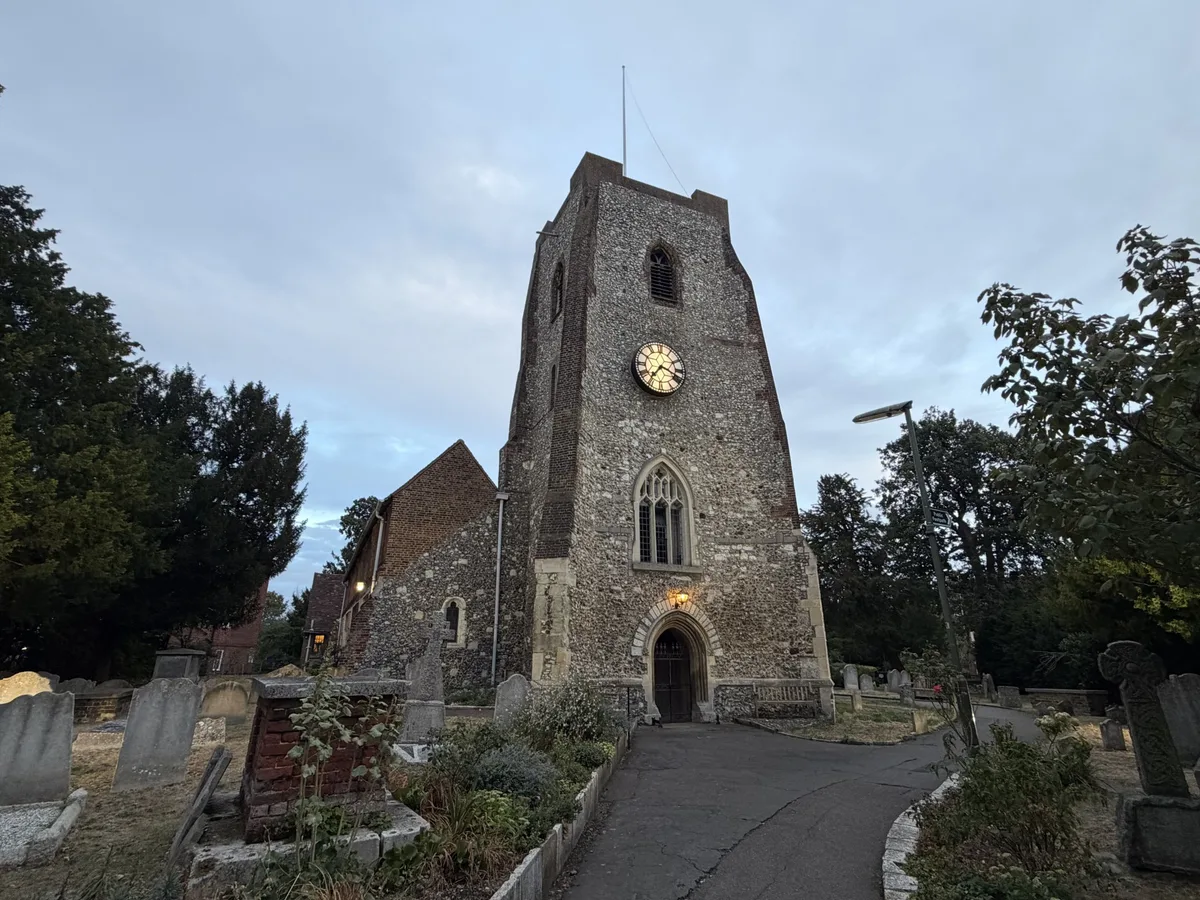
A second incident followed in which Winstanley said a crowd of more than one hundred people, led by John Taylor, took Digger spades and carried some of the group through Walton before they were brought before a justice at Kingston and again released (Winstanley, 1650a/2009; Ratcliffe, 1994).
Elmbridge Museum’s modern Diggers Trail correctly treats St Mary’s as one of the principal surviving locations in the story (Elmbridge Museum, n.d.).
From harassment to organised violence
The plantation did not fall in one decisive eviction. It was worn down through repeated disruption.
Early news reports outlined that attacks took place and the destruction of the colony while the Diggers repeatedly returned and rebuilt. The conflict intensified as they asserted rights not only to cultivate land but also to use common resources such as wood. A confrontation while Diggers attempted to obtain wood from Stoke Common led to damage to a cart and, in Winstanley’s account, the slashing of a mare (Gurney, 2007; Winstanley, 1650a/2009).
The best-documented act of physical violence occurred on 11 June 1649. A contemporary Digger pamphlet accused William Star [Starr] and John Taylor of Walton of arriving on horseback with men disguised in women’s clothing and attacking four Diggers at work. The pamphlet said the workers did not resist. Three eventually walked away, while a fourth was so badly injured that he had to be carried home in a cart. The British Library’s Thomason copy was annotated 22 June, showing that the accusation was circulating within eleven days of the alleged assault (Winstanley et al., 1649/2009; Folger Shakespeare Library, n.d.-a).
The Kingston court case
Physical resistance was joined by litigation.
Proceedings in Kingston Court of Record began in June 1649. The surviving court book is now a key archival source for the movement. The defendants included Gerrard Winstanley, Henry Bickerstaffe and Thomas Starr. The legal actions were brought in the names of Thomas Lord Wenman, Sir Ralph Verney and Richard Winwood, trustees associated with Francis Drake’s Walton interests (Gurney, 1994; Gurney, 2007).
The title page of An Appeal to the House of Commons makes the issue explicit. It asks whether the common people should enjoy commons and waste lands quietly or remain subject to the will of lords of manors. It says the appeal arose from an arrest for trespass in digging on George Hill and names Winstanley, John Barker and Thomas Starr as authors (Winstanley, Barker and Starr, 1649/2009; Folger Shakespeare Library, n.d.-b).
Winstanley’s objection to the legal process was as radical as his objection to the property claim. He complained that the defendants were expected to employ attorneys and could not simply answer for themselves. His later attacks on professional lawyers, obscure law and justice sold for money were therefore partly shaped by his direct experience at Kingston (Winstanley, 1649/2009).
The litigation continued through July. Damages were assessed and Bickerstaffe was imprisoned, although later released. Winstanley described attempts to seize cattle to satisfy the judgment and mocked the notion that animals which had never dug at George Hill could be made to pay for the alleged trespass (Gurney, 2007; Winstanley, 1649/2009).
The case did not instantly end the colony. The Diggers were still associated with St George’s Hill in late July. Their movement towards Little Heath occurred during August. Any account in which they simply lose a June court case and immediately vanish is too compressed.
Francis Drake and the Manor of Walton
Francis Drake has often been described simply as the lord who owned St George’s Hill. The legal position was more complicated.
An older Francis Drake of Esher had held Walton property and made a will in 1633/34. The younger Francis Drake inherited interests connected with the Walton manor and is the figure involved in 1649. Gurney describes him as farmer of the manor and an important local manorial interest rather than as a simple modern freeholder (Gurney, 2007). John Pulford’s Ashley Road School quotes the elder Francis Drake’s 1633/34 will and his endowment involving Walton property, which means that the elder man cannot be the Francis Drake confronting the Diggers fifteen years later (Pulford, 2000).
Drake had parliamentary credentials, and his political position had become difficult by 1649. Again the story refuses easy alignment. A man could support Parliament, oppose royalism and still defend manorial interests against the Diggers.
Little Heath, Cobham, 1649–1650
The move to Little Heath
By 24 August 1649 the Diggers had established a new plantation on Little Heath in Cobham (Gurney, 2007).
This second settlement lasted longer than the one at St George’s Hill and reveals how much local social geography mattered.
At Walton, many Diggers were outsiders. At Little Heath, they were living among neighbours. Gurney estimates that a large proportion of those who moved to the Cobham phase came from Cobham or immediately neighbouring parishes. The local community was therefore divided from within (Gurney, 1994; Gurney, 2007).
Little Heath itself occupied a broader historical common than the modern place-name suggests. The exact positions of the Digger houses have not been identified. The modern Surrey Diggers Trail uses Littleheath Lane as an accessible interpretation point, not as proof of the exact footprint of the 1649 settlement (Elmbridge Museum, n.d.).
On 24 August Winstanley alleged that knights, gentlemen and wealthy freeholders met at the White Lion in Cobham to consider how the Diggers could be suppressed. The historic inn and Portsmouth Road landscape therefore belong to the geography of the second settlement, although continuity between the seventeenth-century building and surviving fabric should be treated cautiously (Gurney, 2007; Winstanley, 1649/2009).
John Platt and the Cobham opposition
The leading opponent at Little Heath was John Platt, rector of West Horsley and holder of a manorial interest in Cobham through marriage.
He should not be projected backwards as the principal enemy on St George’s Hill. Gurney finds no good evidence that he led the Walton opposition. His importance belongs mainly to the Cobham phase (Gurney, 1994; Gurney, 2007).
Nor was Platt a Royalist reactionary in any simple sense. He had supported Parliament. After the Restoration he would himself be ejected from his living for nonconformity. The Digger conflict cut across the political alignments of the Civil War.
In October 1649 central government again became involved after reports of a tumultuous gathering at Cobham. Several Diggers were arrested but were able to use habeas corpus and obtain bail after procedural irregularities. Further Kingston proceedings followed in the autumn (Gurney, 2007).
Late in November, soldiers and countrymen pulled down two Digger houses and removed the materials. The chronology of surviving papers suggests 28 November as a probable date, though that precision should be presented cautiously (Hessayon, 2023, p. 192; Gurney, 2007).
The community nevertheless survived the winter.
A settlement of households, not just male activists
One of the most persistent distortions is to imagine the Diggers as a small camp of unattached men.
They were a community of households. Several identifiable Diggers had wives and dependent children, and the movement’s own appeals referred explicitly to “wives and families” (Gurney, 2007). The social range was also wider than the stereotype of landless agricultural labourers suggests.
John Coulton, probably the “Colten” of Sanders’s report, was a Cobham copyholder with about thirty acres and experience in parish and manorial administration. Thomas Starr was a shoemaker. Henry Bickerstaffe came from a family with substantial interests around Painshill and had been apprenticed in London. Anthony Wrenn had already been prosecuted years earlier for digging and selling turf from manorial waste. Daniel Freeland, Henry Barton, John Hayman and John Palmer occupied more precarious positions. Some later required parish relief, while others became local officeholders (Gurney, 2007).
The Digger programme attracted not only those excluded from customary property but at least some people who possessed rights within the system and nevertheless concluded that the system itself was unjust.
Two women become individually visible only after the destruction of Little Heath. Elizabeth Barton and Jane Edsaw or Edsarr appeared as witnesses when Diggers and supporters later attempted to prosecute the men who had destroyed the settlement. They may have been members of Digger households, perhaps related to Henry Barton and Thomas Edsaw, but those relationships have not been proved. If they were themselves Diggers, they are the only named women currently identified within the Surrey movement (Gurney, 2007).
The final destruction, 19 April 1650
The Diggers became more explicit in challenging the manorial system as the winter passed. An Appeale to All Englishmen, issued on 26 March 1650, declared that the people who had begun at George Hill were now carrying on the public work at Little Heath in the parish of Cobham. Its signatories urged common people to build and plant on waste land and linked that action to the overthrow of “kingly and lordly” bondage (Winstanley et al., 1650/2009).
The same declaration provides one of the best late membership lists, naming twenty-five people associated publicly with the Cobham experiment (Winstanley et al., 1650/2009).
By early April several Diggers were also facing legal proceedings over cottages. Winstanley then accused Platt and Thomas Sutton of another attack in which a pregnant woman was struck and miscarried. This is serious contemporary testimony but remains Winstanley’s allegation rather than an independently corroborated medical or judicial finding (Winstanley, 1650b/2009; Gurney, 2007).
The decisive attack came on Friday 19 April 1650. Draft indictments later prepared against the attackers independently confirm the date. Winstanley named Platt, Thomas Sutton and Sir Anthony Vincent among the organisers and said about fifty men were involved. Six houses were burned. Furniture, clothing and bedding were damaged or dispersed. The remaining corn was left exposed, and men were stationed on the heath to prevent rebuilding (Gurney, 2007). The purpose was not simply to demonstrate opposition. It was to make reconstruction impossible.
At least four people whose houses were destroyed can be identified from later legal material: Henry Barton, Daniel Freeland, Thomas Adams and Robert Sawyer. In July Diggers and local sympathisers attempted to indict around twenty alleged attackers at the Surrey assizes in Croydon. The grand jury rejected the bills, but the surviving drafts are invaluable because they preserve the names of alleged assailants and witnesses (Gurney, 2007). The destruction of 19 April ended the permanent Surrey settlement.
Not quite the end
The practical movement did not disappear overnight. During the summer of 1650 Winstanley and companions worked at Pirton in Hertfordshire for the extraordinary religious prophetess Lady Eleanor Davies. They threshed wheat and performed other estate work while Winstanley tried to interpret the relationship as something more than ordinary wage service. By December the arrangement had collapsed into a dispute over work and accounts (Gurney, 2007; Pirton Local History Group, n.d.).
William Everard reappeared separately at Bradfield in Berkshire, where he offered harvest labour to the religious radical John Pordage. These episodes suggest that former Diggers were still experimenting with labour, religious fellowship and practical community after their permanent colonies had failed (Gurney, 2007).
For that reason it is useful to distinguish two endpoints. 19 April 1650 marks the destruction of the final Surrey Digger settlement. Late 1650 is a defensible endpoint for the last identifiable collective attempts by former Diggers to live out parts of the programme in practice.
Beyond Surrey and beyond 1650
A national movement, but not a national organisation
The Surrey Diggers inspired, corresponded with or became aware of other groups beyond Elmbridge. The best documented independent community was at Wellingborough in Northamptonshire, where poor inhabitants issued a declaration explaining why they had begun cultivating waste ground called Bareshank. The surviving broadside names nine signatories and was already in circulation by 12 March 1650 (Wellingborough Diggers, 1650; Folger Shakespeare Library, n.d.-c).
A second definite community appeared at Iver in Buckinghamshire, whose inhabitants issued their own declaration on 1 May 1650. Its language strongly resembles the Surrey programme while addressing local circumstances (Iver Diggers, 1650).
Other reports mentioned digging at Barnet, Enfield and Dunstable, at an uncertain place called “Cox Hall” in Kent, at a similarly problematic “Bosworth old”, and at unidentified places in Gloucestershire and Nottinghamshire. With the exception of Wellingborough and Iver, the evidence is thin. These should be classified as reported activity rather than treated as equally well-documented colonies (Gurney, 2007; Elmbridge Museum, 2022a).
By spring 1650 the Surrey community was actively trying to spread the movement. Travelling activists carried letters, solicited support and moved through several counties. Yet there was no national Digger organisation, no formal chain of command and no evidence that Winstanley appointed local leaders. The best description is a decentralised network connected through print, travellers, religious contacts and a shared language of land, labour, poverty and freedom (Gurney, 2007).
St George’s Hill therefore matters nationally not because every Digger idea was invented there, but because it appears to have been the earliest securely documented attempt to turn those ideas into sustained collective cultivation of common land. Surrey made the programme visible and reproducible, and may have inspired others to act.
What Winstanley actually believed
Later generations have called Winstanley a communist, socialist, anarchist, environmentalist and libertarian. Each label captures something, however none should replace the seventeenth-century language in which he understood himself.
His thought began from creation and the Fall. God, Reason or the Spirit existed within creation and within people. Human selfishness, covetousness and the desire to rule produced outward systems of domination. A genuinely free society therefore required both inward transformation and material change (Corns, Hughes and Loewenstein, 2009; Bradstock, 1997).
The control of land was fundamental because land supplied the material basis of life. Political liberty meant little if a person still had to submit to a landlord or employer simply to obtain food. “True Commonwealths Freedom”, Winstanley later argued, lay in free enjoyment of the earth (Winstanley, 1652/2009).
He opposed rent and wage dependence, but not work. His imagined commonwealth was intensely productive. Everyone capable of labour would contribute. Education would combine reading and intellectual enquiry with practical trades, agriculture and science. He objected to a social division in which one class monopolised learning while living from the labour of others (Winstanley, 1652/2009).
Nor did common ownership mean that anybody could seize another family’s household goods. In The Law of Freedom he distinguished the common ownership of productive resources from protected personal and household possession. Families would retain homes and domestic goods (Winstanley, 1652/2009).
His mature plan went much further than the 1649 digging. Domestic buying and selling were ultimately to disappear in favour of common storehouses. Public officers would be elected and regularly rotated. Laws would be written plainly enough to reduce dependence on professional lawyers. Clerical monopoly and compulsory tithes would disappear. Yet The Law of Freedom also envisaged government, judges and punishment. For that reason it cannot simply be described as an anarchist constitution (Winstanley, 1652/2009).
His approach to violence requires the same nuance. The Digger experiment was deliberately non-violent. Their pamphlets rejected conquest by weapons and emphasised patience, labour and persuasion. Ratcliffe preserves the associated Digger aspiration to conquer opponents through love (Ratcliffe, 1994).
Women reveal both the radicalism and limits of his thought. Digger writings could speak of men and women alike as complete creations containing the divine spirit, and Winstanley rejected wealth and social rank as proper determinants of marriage. Yet his mature political order remained patriarchal and did not establish equal female political office. It is better to describe his gender thinking as unusually expansive in some respects while still constrained by seventeenth-century assumptions (Corns, Hughes and Loewenstein, 2009).
The Law of Freedom came after defeat
The most elaborate version of Winstanley’s social vision appeared in 1652, when he published The Law of Freedom in a Platform and dedicated it to Oliver Cromwell.
It is important not to read the book backwards into April 1649. The first Diggers did not arrive on St George’s Hill with a complete constitutional blueprint. The early programme was experimental: cultivate waste, work together, reject rent and hired dependence, demonstrate common livelihood, persuade others to follow.
The Law of Freedom answered a later question. If common freedom governed an entire nation, what institutions would it need?
The answer included elected officers, parliaments, education, storehouses, family households, public works and law. It also contained tensions. Winstanley remained suspicious of concentrated power while designing institutions powerful enough to enforce the commonwealth. Scholars have therefore disagreed over whether the book marks retreat, maturation or adaptation after the failures of 1649–1650 (Corns, Hughes and Loewenstein, 2009; Webb, 2004).
What should not be lost is the local connection. His distrust of lawyers had been tested at Kingston. His attack on manorial lordship had been tested at Walton. His commitment to communal labour had been tested at St George’s Hill and Little Heath. The political theory cannot be detached from the Elmbridge landscape in which it was tried.
What happened to the Diggers?
Many former Diggers returned to ordinary local society more easily than the image of permanent revolutionary outcasts suggests. Thomas Starr later served as a tithingman and waywarden. John Hayman held parish offices. Henry Bickerstaffe, who had been imprisoned during the Digger litigation, later became keeper of Kingston gaol. John Coulton returned to conventional family and property affairs. Winstanley himself became waywarden, overseer of the poor and churchwarden in Cobham, later serving on a quarter-sessions jury and becoming High Constable of Elmbridge Hundred in 1671 (Gurney, 2007; Vann, 1965). The irony is obvious, but it should not be simplified into a morality tale about a radical who “sold out”. Surviving parish records suggest Winstanley took poor relief and charitable administration seriously. His methods changed because the revolutionary circumstances had changed. That does not tell us exactly how much of his earlier social vision he still privately held.
Some former Diggers and their families moved towards early Quakerism. Thomas Starr later refused to assist the arrest of Quakers. Members of the Barton and Hayman networks appear in Friends’ records. Winstanley’s own religious trajectory is more complicated because he held Church of England parish office in the 1660s, but by the end of his life his Quaker association was strong (Gurney, 2007; Vann, 1965).
Winstanley died on 10 September 1676. The Westminster Friends’ register described him as a corn chandler. By July that year his name also appeared among Friends attending a Quaker marriage. The evidence strongly supports identifying this man with the former Digger leader (Vann, 1965; Gurney, 2007).
That date is worth stressing because later ideological literature sometimes got it badly wrong. The Soviet book Names on an Obelisk, published in English in 1983, gives Winstanley as 1609–1652 and concludes that nobody knew where or when he died, supposing death around 1652 (Valovoi and Lapshina, 1983, pp. 144–156). The error is useful evidence of the state of Soviet popular historiography, not of Winstanley’s actual biography.
Place, landscape and memory
Where exactly did they dig?
The exact location of the original plantation remains one of the largest unresolved questions.
Sanders’s report gives the best clue: they dug on the side of St George’s Hill “next to Campe Close” (Firth, 1894, p. 194).
John Gurney interprets the phrase as pointing towards the vicinity of the Iron Age hillfort on the summit. Later local topography also preserved a “Camp Close” associated broadly with the ancient camp and Oatlands. Modern Camp End Road physically crosses the archaeological landscape of the hillfort. Historic England records surviving ramparts immediately north and south of the road (Gurney, 2007; Historic England, n.d.).
Together these clues make the hillfort and Camp End Road landscape the strongest general candidate, but not a proven exact site.
Alternative suggestions include ground beneath the south-western ramparts and, more speculatively, land towards Silvermere. No archaeological evidence has fixed the settlement to a particular modern house or garden. Archaeological work at Ravenridge on Camp End Road did not find remains attributable to the Diggers, although a temporary seventeenth-century occupation would be difficult to detect after centuries of landscaping and development.
The current Digger memorial near Brooklands Road does not mark the original plantation. It is a commemorative site chosen because placing the stone on St George’s Hill proved impractical. Likewise, the 1999 Diggers 350 occupation at Camp End Road and Old Avenue was a deliberate act of modern commemoration, not proof that activists had rediscovered the exact 1649 plot (The Land Is Ours, 1999; Surrey Archaeological Society, 2001).
Two local works remain particularly important for future site research: Shirley Martin’s Field Names & Minor Place Names of Walton & Weybridge (1984) and Michael E. Blackman’s St George’s Hill, Weybridge (1988), both listed in Walton and Weybridge Local History Society bibliographies. The seventeenth-century manorial and parliamentary surveys identified by Gurney offer an even stronger archival route.
The places in the story
The table below gathers the places named in this article and states how precisely each can be located today, using only the evidence discussed above. It is not a visitor guide: much of St George’s Hill is now private residential land, and no route across it is implied.
| Place | Role in the story | How precisely it can be located |
|---|---|---|
| St George’s Hill (“George Hill”) | First plantation, April to August 1649, described by the Diggers as in the parish of Walton | The hill is secure. The exact plot is unresolved. |
| Campe Close | Sanders’s landmark for the first digging | Not securely identified. The hillfort and Camp End Road landscape is the strongest general candidate. |
| St Mary’s Church, Walton-on-Thames | Diggers carried there as prisoners, by Winstanley’s account | Secure: the church still stands. |
| Kingston | Court of Record proceedings; justices before whom Diggers were brought | Secure as a town. |
| Painshill | Area associated with William Starr and with Henry Bickerstaffe’s family | Broad area only. |
| Stoke Common | Diggers attacked while fetching wood, by Winstanley’s account | Not located further in this article. |
| Little Heath, Cobham | Second settlement, August 1649 to 19 April 1650 | A broader historic common than the modern name suggests. The positions of the houses are unknown. Littleheath Lane is an interpretation point on the Surrey Diggers Trail, not the settlement’s footprint. |
| White Lion, Cobham | Where Winstanley alleged opponents met on 24 August 1649 | Continuity with any surviving building is not established. |
| Camp End Road and Old Avenue | Site of the 1999 Diggers 350 reoccupation | A modern commemorative action, not evidence of the 1649 plot. |
| Memorial near Brooklands Road | Modern Digger memorial | Commemorative only. It does not mark the original plantation. |
The landscape after the Diggers
The commons did not become Winstanley’s common treasury.
Over the following century and a half the legal and physical landscape changed profoundly. The Walton Inclosure Act of 1800 authorised the division, allotment and enclosure of open common fields, meadows, pastures, commons and waste land in Walton and Walton Leigh (Stonebanks, 1982).
Later boundary changes further obscured the historical geography. Areas once understood within the ancient Walton parish became associated with Hersham, Oatlands and Weybridge. Modern St George’s Hill was transformed again after W. G. Tarrant acquired the estate in the twentieth century and developed the exclusive residential landscape familiar today.
The result is historical irony. One of England’s most famous experiments in common use of land is now remembered on a hill synonymous with private residential exclusivity.
Rediscovering Winstanley
The Diggers were not continuously celebrated after 1650. Their modern fame is largely the product of later rediscovery and reinterpretation.
Nineteenth-century historians and political writers began recovering the radical pamphlet literature of the Civil War. Eduard Bernstein was especially influential in placing Winstanley within a history of socialism. Lewis Berens’s 1906 study likewise presented him as a communist and social reformer. Christopher Hill then brought Winstanley and the wider radical culture of the English Revolution to a much larger twentieth-century readership, especially through The World Turned Upside Down (Hill, 1972; Gurney, 2017).
These interpretations rescued the Diggers from obscurity, but they also encouraged a tendency to convert Winstanley too quickly into a precursor of later ideologies. Modern scholarship has placed greater weight on theology, local society, gender, rhetoric, print culture and the specific economic world of commons and manors (Corns, Hughes and Loewenstein, 2009; Gurney, 2007; Gurney, 2017).
The best approach is therefore to distinguish two questions: what Winstanley and the Diggers believed in their own time, and what later movements found useful in them.
A name on a Soviet obelisk
One of the most remarkable examples of later appropriation occurred in revolutionary Russia.
In 1918 the Soviet authorities transformed an obelisk in Moscow’s Alexander Garden into a monument carrying the names of revolutionary and socialist thinkers. Gerrard Winstanley appeared among nineteen names alongside Marx, Engels, Thomas More, Campanella, Saint-Simon, Fourier, Proudhon, Bakunin and others (Valovoi and Lapshina, 1983, pp. 7–10).
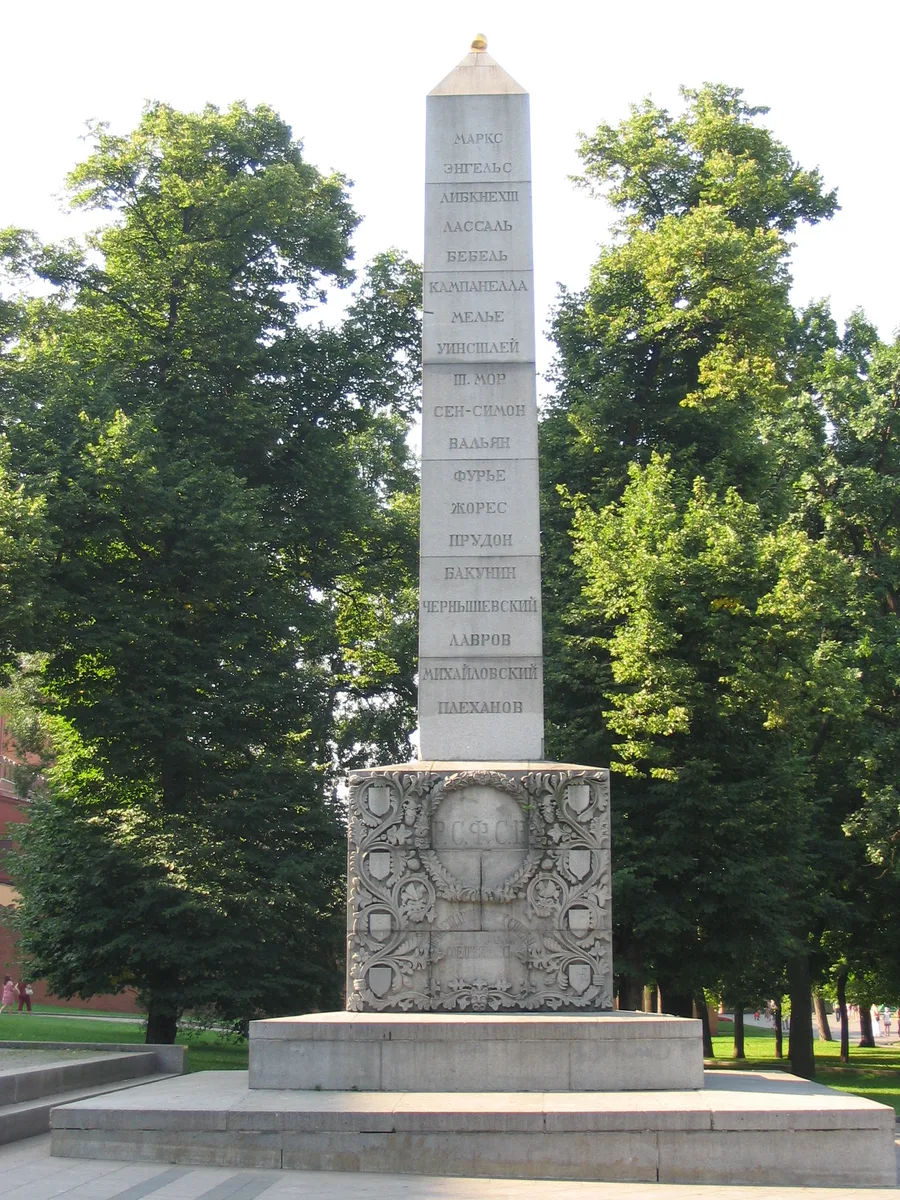
The names are inscribed in a single column, with Winstanley eighth:
- Karl Marx
- Friedrich Engels
- Wilhelm Liebknecht
- Ferdinand Lassalle
- August Bebel
- Tommaso Campanella
- Jean Meslier
- Gerrard Winstanley
- Thomas More
- Claude-Henri Saint-Simon
- Edouard Vaillant
- Charles Fourier
- Jean Jaurès
- Pierre-Joseph Proudhon
- Mikhail Bakunin
- Nikolay Chernyshevsky
- Pyotr Lavrov
- Nikolay Mikhaylovsky
- Georgi Plekhanov
The 1983 English-language Soviet book Names on an Obelisk is valuable precisely because it shows how this commemoration was explained. Its authors place Winstanley among the founders of “Utopian socialism” and describe his thought through the later Marxist-Leninist categories of class, private ownership and the transition towards scientific socialism. They present the Diggers as representatives of propertyless and poor peasant strata and interpret Winstanley’s common land programme as an anticipation of later socialist thought (Valovoi and Lapshina, 1983, pp. 144–156).
As an account of 1649 the chapter is uneven. It compresses the chronology, treats class divisions more schematically than modern local scholarship allows, places the destruction of houses at St George’s Hill at the end of November when that episode belongs to the Little Heath phase, and gives Winstanley’s death year incorrectly. Its historical importance lies elsewhere. It demonstrates how completely a seventeenth-century Christian radical could be absorbed into the official genealogy of Soviet socialism.
That is reception history, not evidence that Winstanley was a Marxist three centuries early.
Film, counterculture and modern land politics
The Diggers acquired another life through art and activism.
Kevin Brownlow and Andrew Mollo’s 1975 film Winstanley, adapted from David Caute’s Comrade Jacob, remains one of the most influential visual representations of the movement. The British Film Institute praises its unusual commitment to material authenticity, while also noting that Caute thought the film underplayed some of Winstanley’s contradictions and religious intensity (Brownlow and Mollo, 1975; BFI, 2025).
The film should therefore be valued as a powerful historical interpretation, not treated as documentary evidence for the appearance of the Surrey settlements.
Across the Atlantic, the San Francisco Diggers of the 1960s consciously reused the English name for a very different countercultural movement centred on free food, free stores, street theatre and rejection of commercial exchange. The relationship was inspirational rather than organisational.
Closer to home, the land-rights group The Land Is Ours returned deliberately to St George’s Hill in April 1999 for the 350th anniversary. Around 300 activists marched from Walton-on-Thames and established a temporary camp near Camp End Road and Old Avenue (The Land Is Ours, 1999). Their action demonstrated the continuing ability of Winstanley’s language to frame modern arguments about access to land, while also creating another layer of memory around a site whose exact seventeenth-century footprint remains uncertain.
The Surrey Diggers Trail followed in 2005, linking Cobham, St George’s Hill, St Mary’s Walton, Little Heath and the modern memorial. Elmbridge Museum has since redeveloped and expanded the interpretation with new research (Elmbridge Museum, n.d.).
The Diggers in song: a voice from 1650
The Diggers did not communicate their ideas through pamphlets and petitions alone. They also used song.
The best-known surviving example begins with a call for the Diggers to stand together. Its verses describe their attempts to cultivate common land, the destruction of their houses and their opposition to the landowning gentry, lawyers and clergy. It ends by presenting love, rather than violence, as the means of overcoming their opponents. The song is a remarkable historical source because it gives us a different kind of testimony from the legal records and political pamphlets. It conveys the movement’s sense of shared purpose while revealing how its members understood the hostility they faced.
Its origins, however, are not entirely settled. The surviving text is anonymous, untitled and undated. It was copied into the papers of Sir William Clarke, a secretary to the parliamentary army’s commander, Thomas Fairfax, probably between March and May 1650. It remained unpublished until historian Charles Harding Firth printed it in 1894 and gave it the title The Diggers’ Song. Firth suggested that Gerrard Winstanley was its author. Historian Ariel Hessayon has since argued that Robert Coster, another Digger who published verse, is also a plausible candidate. Hessayon dates the composition to either December 1649 or around March 1650, during the movement’s occupation of Little Heath in Cobham. The original melody is also uncertain, so modern performances cannot be regarded as exact reconstructions of how the Diggers sang it (Hessayon, 2023, pp. 189–193).
The Diggers’ story subsequently inspired new music. In 1975, songwriter Leon Rosselson released The World Turned Upside Down, a separate composition based on the movement’s history and Winstanley’s writings. Later recordings helped carry the story of St George’s Hill to audiences far beyond Surrey. The two songs should not be confused: one is a surviving expression of the seventeenth-century movement; the other is a modern interpretation of its legacy (Rosselson, 1975).
Assessing the Diggers
What popular accounts often miss
The research behind this article changes the familiar story in several important ways.
St George’s Hill should not be treated solely as Weybridge history. The Diggers themselves placed it in Walton parish.
The first five were reported as Cobham men, and Winstanley is not named among them. Everard is the most prominent named figure in the earliest report, although Winstanley quickly became the movement’s chief writer and intellectual leader.
The starting date is traditionally 1 April but may have been 8 April.
Walton opposition was not simply the work of rich landlords. Many local commoners had customary rights of their own and could see the Diggers as outsiders threatening those rights.
The Diggers were not all landless labourers. Their ranks included tradesmen, householders, a substantial copyholder and people connected to local administration.
The Kingston litigation concerned trespass and manorial rights. Claims in some popular accounts that the Diggers were judicially found to be sexually libertine “Ranters” do not belong to the documented Kingston case.
Little Heath was not a short afterthought. It was a substantial second phase in which Cobham’s local social divisions became central.
Reports of national Digger activity vary greatly in quality. Wellingborough and Iver are well documented. Barnet, Enfield, Dunstable, “Cox Hall”, “Bosworth old”, Gloucestershire and Nottinghamshire are far less securely recoverable.
The Digger movement should not be labelled too simply as a split from the Levellers, nor Winstanley reduced to a modern political category. His thought was inseparably religious, and The Law of Freedom contained government and coercive law as well as communal ownership.
Finally, the present memorial does not identify the original Digger cultivation, and no exact modern property can presently be proved to occupy the first plantation.
Why the Diggers failed
There was no single cause.
At Walton they confronted a local society in which common rights were already allocated and defended. Their universal claim did not necessarily look liberating to people who possessed modest customary rights of their own.
They were poor and economically fragile. Buildings, tools, crops and animals were repeatedly attacked. Litigation consumed resources. Their opponents could mobilise local office, manorial influence, courts and eventually organised force.
At Cobham the community had deeper local roots, but this produced a different suppression rather than safety. Gentry and manorial interests coordinated opposition, houses were destroyed and neighbouring dependants were drawn into the campaign.
The wider movement also lacked central organisation, secure finance and political protection. Fairfax might regard a small band of diggers as harmless, but neither he nor the Commonwealth government accepted their claim to remake property relations.
Yet calling the experiment a simple failure misses its significance. The Diggers survived months of violence and legal pressure, generated an extraordinary body of writing, spread their example beyond Surrey and forced contemporaries to confront a question the new Commonwealth preferred not to answer: if England had overthrown a king in the name of liberty, how far was liberty supposed to go?
A Walton and Cobham story with national consequences
The Surrey Diggers make most sense when returned to their local landscape.
They were not abstract political philosophers dropped onto a symbolic hill. They were Cobham tradesmen, copyholders, failed merchants and householders. Their opponents were Walton commoners, freeholders, clergy, manorial interests, magistrates and officials who themselves had complicated Civil War allegiances. St Mary’s Church, Painshill, Kingston, Little Heath, Stoke Common and the roads between them all mattered.
The local geography also explains the movement’s different fortunes. At St George’s Hill, predominantly Cobham-based activists cultivated Walton common and met considerable popular hostility. At Little Heath, Diggers were operating inside their own local community, where suppression had to be organised more clearly through gentry, legal and manorial power (Gurney, 1994).
That Walton-Cobham contrast is one of the most important findings of modern scholarship, and one of the features most often lost when the Diggers are reduced to a paragraph about “Weybridge”.
For Walton-on-Thames, the connection is direct. The Diggers’ own manifesto named George Hill as part of Walton parish. Walton men reported them, opposed them and attacked them. Diggers were imprisoned in St Mary’s. The legal struggle concerned rights claimed through the Manor of Walton. The controversy cannot be understood properly without Walton-on-Thames.
What remains uncertain
A definitive history should make uncertainty visible rather than conceal it.
The exact starting date remains 1 or 8 April 1649.
The two unnamed members of the original five have not been securely identified.
Winstanley’s exact role on the first day remains uncertain because Sanders does not name him among the first five, while Winstanley’s later recollection places himself at the beginning.
The precise position of Campe Close and therefore the exact first cultivated plot remain unresolved.
The precise modern footprint of the six Little Heath houses is unknown.
The identities of the two contemporary Walton men named John Taylor are not fully disentangled in every episode.
The relationships of Elizabeth Barton and Jane Edsaw to known Digger men remain to be proved.
Some reported national Digger communities, especially Cox Hall, Bosworth, Gloucestershire and Nottinghamshire, cannot presently be located or reconstructed with confidence.
Further work in the seventeenth-century Walton, Walton Leigh, Oatlands, Painshill and Cobham surveys could materially improve the landscape reconstruction. Shirley Martin’s field-name study and Michael Blackman’s St George’s Hill history are also priority local sources for checking Campe Close.
Conclusion
The Diggers’ year in Surrey was short, but it was not simple.
Five men from Cobham began by planting vegetables on the edge of Walton’s commons. Within days they had attracted national government attention. Within weeks they were publishing manifestos. Within months they had been imprisoned in Walton church, assaulted, sued at Kingston and forced to rebuild elsewhere. At Little Heath their community survived winter, involved families as well as activists and challenged the manorial order more openly before its houses were deliberately burned.
The movement’s local opponents were not a single class. Some were manorial interests and clergy. Others were Walton freeholders and commoners defending rights they regarded as their own. The Diggers themselves were equally varied. They included poor householders, tradesmen, a substantial copyholder and people from families connected with local government and property.
That is why the story is richer than the familiar morality tale of poor communists against rich landlords.
Its deepest conflict concerned the meaning of freedom. Was freedom the protection of an established commoner’s customary right? Was it the security of property recognised by law? Or did political freedom remain hollow while one person controlled the land from which another had to obtain a living?
Winstanley answered with the most radical proposition of the English Revolution: the earth had been made for common preservation, and liberty required material access to it.
The experiment failed. The houses disappeared. The commons were eventually enclosed. Winstanley returned to conventional local office and died as a London corn chandler associated with the Quakers.
Yet the question raised on St George’s Hill did not disappear with the settlement. It travelled through Wellingborough and Iver, through Winstanley’s later writings, through socialist and anarchist histories, through Soviet commemoration, film, counterculture and modern land-rights campaigns.
And its first sustained practical test remains inseparable from Walton-on-Thames and Cobham. The Diggers did not merely happen somewhere near Walton. Their own words placed George Hill in Walton parish, their opponents included Walton people, their prisoners were held in Walton church and their legal struggle arose from the common-land world of the Manor of Walton.
For the history of Walton-on-Thames, that makes the Diggers not a footnote to a national story but one of the town’s most important contributions to the history of political and social thought.
Chronology and people
Chronology, 1648–1652
| Date | Event | Evidential position |
|---|---|---|
| 1648 | Winstanley publishes early religious writings and develops his critique of covetousness, property and domination | Well established |
| January 1649 | The New Law of Righteousness moves towards practical cultivation of common land | Well established |
| 30 January 1649 | Charles I executed | Established national chronology |
| 1 or 8 April 1649 | Five Cobham men begin digging St George’s Hill beside “Campe Close” | Event certain; exact Sunday uncertain |
| 16 April | Henry Sanders reports the Diggers to the Council of State | Primary manuscript evidence |
| 16 April | Council of State asks Fairfax to send horse towards Cobham | Primary state evidence |
| 19 April | Captain Gladman reports Winstanley and Everard as chief persuaders and sees little danger | Primary military correspondence |
| 20 April | Winstanley and Everard appear before Fairfax at Whitehall | Contemporary reporting |
| Late April | The True Levellers Standard Advanced identifies George Hill as in Walton parish | Surviving printed primary source |
| April–May | Diggers seized, imprisoned in St Mary’s Walton and repeatedly dispersed | Winstanley’s testimony, supported by contemporary context |
| Late May | Fairfax personally visits St George’s Hill | Contemporary news report |
| 9 June | Winstanley addresses Fairfax again | Primary printed source |
| 11 June | William Starr and John Taylor allegedly lead violent attack on four Diggers | Contemporary Digger pamphlet |
| 22 June | Thomason dates surviving copy of pamphlet publicising attack | Bibliographical evidence |
| 23 June | Kingston Court of Record proceedings underway | Surviving court record |
| 11 July | An Appeal to the House of Commons in circulation | Thomason / bibliographical evidence |
| 24 July | Diggers still associated with St George’s Hill | Contemporary reporting |
| 28 July | Damages assessed in Kingston proceedings | Court record reconstruction |
| 11 August | Writ of execution follows | Court record reconstruction |
| By 24 August | Little Heath settlement established in Cobham | Strong documentary reconstruction |
| 24 August | Winstanley says opponents met at White Lion, Cobham | Contemporary partisan testimony |
| 10 October | Council of State responds to reports of gathering at Cobham | Primary state evidence |
| Autumn 1649 | Further arrests and Kingston proceedings | Archival evidence |
| Late November, probably 28 November | Two Digger houses destroyed at Little Heath | Strong evidence; exact date probable |
| Winter 1649–50 | Little Heath survives and crops remain under cultivation | Strong secondary reconstruction from primary material |
| 1 March 1650 | Four Digger cottages formally challenged | Archival evidence |
| 12 March | Wellingborough declaration already in circulation | Thomason annotation |
| 26 March | An Appeale to All Englishmen issued from Little Heath with 25 names | Primary broadside |
| 1 April | Fifteen Diggers indicted at Southwark over earlier St George’s Hill activity | Archival evidence |
| Early April | Surrey emissaries travel through several counties and are apprehended at Wellingborough | Contemporary report |
| 9 April | Introductory portion of An Humble Request dated | Primary printed evidence |
| 19 April | Six houses at Little Heath burned; permanent Surrey settlement destroyed | Winstanley plus independent assize material |
| 1 May | Iver Diggers issue their own declaration | Primary broadside |
| July | Attempt to prosecute alleged Little Heath attackers fails before grand jury | Archival evidence |
| August–December | Winstanley and companions work at Pirton | Surviving letters and local records |
| 1652 | The Law of Freedom in a Platform published | Established bibliography |
Key people
| Name | Role and significance |
|---|---|
| Gerrard Winstanley | Cobham resident, writer and principal intellectual voice of the Diggers; later High Constable of Elmbridge Hundred |
| William Everard | Former soldier, named among the first diggers and initially a leading public figure |
| Thomas Starr | Cobham shoemaker, probable “Stewer” in Sanders’s report, long-term Digger; not William Starr |
| John Coulton | Cobham copyholder with roughly thirty acres, probable “Colten” in Sanders’s report |
| Henry Bickerstaffe | Digger from a substantial local family with Painshill connections; defendant in Kingston litigation; later keeper of Kingston gaol |
| John Palmer | Persistent Surrey Digger from the early phase through Little Heath |
| Henry Barton | Cobham Digger and householder; one of those whose Little Heath homes were destroyed |
| Daniel Freeland | Cobham Digger and householder; later economically vulnerable |
| Anthony Wrenn | Digger with an earlier history of conflict over use of manorial waste |
| John Hayman | Cobham Digger later reintegrated into parish office |
| Richard Maidley/Medley | Digger probably connected with Walton; later witness against the Little Heath attackers |
| Elizabeth Barton | Witness supporting the Diggers after Little Heath; possible female participant, relationship to Henry Barton unproved |
| Jane Edsaw/Edsarr | Witness supporting the Diggers; possible female participant, relationship to Thomas Edsaw unproved |
| Henry Sanders | Walton yeoman whose 16 April report triggered government intervention |
| William Starr | Walton-area freeholder and Digger opponent associated with the 11 June attack; not Thomas Starr |
| John Taylor | Walton opponent repeatedly named by Winstanley; exact identification between contemporary men of that name remains difficult |
| Francis Drake | Major manorial interest in Walton associated with litigation against the Diggers |
| John Platt | Rector of West Horsley and manorial interest in Cobham; principal opponent during Little Heath phase |
| Sir Anthony Vincent | Stoke d’Abernon figure associated with the final suppression; older histories sometimes misidentified him as Sir Francis Vincent |
| Thomas Fairfax | Lord General who investigated the movement, met Winstanley and Everard and later visited St George’s Hill |
References
Citations in the text use the Harvard author-date system, and each links to its entry below. The list follows APA 7. A date written as 1649/2009 gives the original year of publication followed by the modern edition cited. Printed and archival sources are listed from the editor's research record whether or not they are available online.
Primary and contemporary sources
- Everard, W., Palmer, J., South, J., Courton, J., Taylor, W., Clifford, C., Barker, J., Winstanley, G., Goodgroome, R., Starr, T., Hoggrill, W., Sawyer, R., Eder, T., Bickerstaffe, H., & Taylor, J. (1649/2009). A declaration to the powers of England (The true Levellers standard advanced). In T. N. Corns, A. Hughes, & D. Loewenstein (Eds.), The complete works of Gerrard Winstanley (Vol. 2). Oxford University Press.Back to text where this source was cited
- Firth, C. H. (Ed.). (1894). The Clarke papers: Selections from the papers of William Clarke, secretary to the Council of the Army, 1647–1649, and to General Monck and the commanders of the army in Scotland, 1651–1660 (Vol. 2). Camden Society. https://www.cambridge.org/core/journals/camden-new-series/article/abs/clarke-papers/9EE88679D86B4B23A987345614345610Back to text where this source was cited
- Folger Shakespeare Library. (n.d.-a). A declaration of the bloudie and unchristian acting of William Star and John Taylor of Walton [Catalogue record]. https://catalog.folger.edu/record/508576Back to text where this source was cited
- Folger Shakespeare Library. (n.d.-b). An appeal to the House of Commons [Catalogue record]. https://catalog.folger.edu/record/521283Back to text where this source was cited
- Folger Shakespeare Library. (n.d.-c). A declaration of the grounds and reasons why we the poor inhabitants of the town of Wellingborough ... have begun and give consent to dig up, manure and sow corn upon the common, and waste ground, called Bareshanke [Catalogue record]. https://catalog.folger.edu/record/343949Back to text where this source was cited
- Iver Diggers. (1650). A declaration of the grounds and reasons, why we the poor inhabitants of the parish of Iver in Buckinghamshire, have begun to digge and mannure the common and waste land. https://www.exclassics.com/pamphlets/pamph010.htmBack to text where this source was cited
- Wellingborough Diggers. (1650). A declaration of the grounds and reasons why we the poor inhabitants of the town of Wellingborough ... have begun and give consent to dig up, manure and sow corn upon the common, and waste ground, called Bareshanke. Folger Shakespeare Library. https://catalog.folger.edu/record/343949Back to text where this source was cited
- Winstanley, G. (1649/2009). A watch-word to the City of London, and the Armie. In T. N. Corns, A. Hughes, & D. Loewenstein (Eds.), The complete works of Gerrard Winstanley (Vol. 2). Oxford University Press.Back to text where this source was cited
- Winstanley, G. (1650a/2009). A new-yeers gift for the Parliament and Armie. In T. N. Corns, A. Hughes, & D. Loewenstein (Eds.), The complete works of Gerrard Winstanley (Vol. 2). Oxford University Press.Back to text where this source was cited
- Winstanley, G. (1650b/2009). An humble request, to the ministers of both universities, and to all lawyers in every Inns-a-Court. In T. N. Corns, A. Hughes, & D. Loewenstein (Eds.), The complete works of Gerrard Winstanley (Vol. 2). Oxford University Press.Back to text where this source was cited
- Winstanley, G. (1652/2009). The law of freedom in a platform. In T. N. Corns, A. Hughes, & D. Loewenstein (Eds.), The complete works of Gerrard Winstanley (Vol. 2). Oxford University Press.Back to text where this source was cited
- Winstanley, G., Barker, J., & Starr, T. (1649/2009). An appeal to the House of Commons. In T. N. Corns, A. Hughes, & D. Loewenstein (Eds.), The complete works of Gerrard Winstanley (Vol. 2). Oxford University Press. Folger catalogue record: https://catalog.folger.edu/record/521283Back to text where this source was cited
- Winstanley, G., et al. (1649/2009). A declaration of the bloudie and unchristian acting of William Star and John Taylor of Walton. In T. N. Corns, A. Hughes, & D. Loewenstein (Eds.), The complete works of Gerrard Winstanley (Vol. 2). Oxford University Press. Folger catalogue record: https://catalog.folger.edu/record/508576Back to text where this source was cited
- Winstanley, G., et al. (1650/2009). An appeale to all Englishmen, to judge between bondage and freedome. In T. N. Corns, A. Hughes, & D. Loewenstein (Eds.), The complete works of Gerrard Winstanley (Vol. 2). Oxford University Press. https://famineanddearth.exeter.ac.uk/displayhtml.html?id=fp_00534_en_anappealeBack to text where this source was cited
Specialist scholarship
- Bradstock, A. (1997). Faith in the revolution: The political theologies of Müntzer and Winstanley. SPCK.Back to text where this source was cited
- Corns, T. N., Hughes, A., & Loewenstein, D. (Eds.). (2009). The complete works of Gerrard Winstanley (2 vols.). Oxford University Press. https://research.bangor.ac.uk/en/publications/the-complete-works-of-gerrard-winstanley/Back to text where this source was cited
- Gurney, J. (1994). Gerrard Winstanley and the Digger movement in Walton and Cobham. The Historical Journal, 37(4), 775–802. https://doi.org/10.1017/S0018246X00015090Back to text where this source was cited
- Gurney, J. (2007). Brave community: The Digger movement in the English Revolution. Manchester University Press. https://manchesteruniversitypress.co.uk/9780719061028/Back to text where this source was cited
- Gurney, J. (2017). Gerrard Winstanley and the Left. Past & Present, 235(1), 179–206. https://doi.org/10.1093/pastj/gtx017Back to text where this source was cited
- Hessayon, A. (2008). Restoring the Garden of Eden in England's green and pleasant land: The Diggers and the fruits of the earth. Journal for the Study of Radicalism, 2(2), 1–25. https://doi.org/10.1353/jsr.0.0004Back to text where this source was cited
- Hessayon, A. (2014). Gerrard Winstanley and Jacob Boehme. In A. Hessayon & D. Finnegan (Eds.), Varieties of seventeenth- and early eighteenth-century English radicalism in context. Ashgate.Back to text where this source was cited
- Hessayon, A. (2023). The Diggers' Song. Notes and Queries, 70(3), 189–193. https://doi.org/10.1093/notesj/gjad040Back to text where this source was cited
- Hill, C. (1972). The world turned upside down: Radical ideas during the English Revolution. Temple Smith.Back to text where this source was cited
- Roberge, L. B. (2022). Identity matters: The story of how the diggers became the Diggers. Elmbridge Museum. https://elmbridgemuseum.org.uk/network/4-identity-matters-the-story-of-how-the-diggers-became-the-diggers/Back to text where this source was cited
- Vann, R. T. (1965). The later life of Gerrard Winstanley. Journal of the History of Ideas, 26(1), 133–136.Back to text where this source was cited
- Webb, D. (2004). Gerrard Winstanley's The Law of Freedom and the limits of radical political thought. Political Studies, 52(4), 755–771.Back to text where this source was cited
Local history and heritage
- Elmbridge Museum. (2022a). The aftermath of the Diggers at Little Heath. https://elmbridgemuseum.org.uk/network/6-the-aftermath-of-the-diggers-at-little-heath/Back to text where this source was cited
- Elmbridge Museum. (n.d.). The Surrey Diggers Trail. https://elmbridgemuseum.org.uk/surrey-diggers-trail/Back to text where this source was cited
- Historic England. (n.d.). Large multivallate hillfort on St George's Hill (List Entry 1008475). https://historicengland.org.uk/listing/the-list/list-entry/1008475Back to text where this source was cited
- Pirton Local History Group. (n.d.). The Diggers in Pirton. https://pirtonhistory.org.uk/articles/the-diggers-in-pirton/Back to text where this source was cited
- Pulford, J. S. L. (2000). Ashley Road School, Walton-on-Thames. Walton and Weybridge Local History Society.Back to text where this source was cited
- Ratcliffe, E. (1994). Winstanley's Walton, 1649: Events in the Civil War at Walton-on-Thames; The 'Lights' in Walton St Mary; Gerrard Winstanley and the Diggers. Astrapost.Back to text where this source was cited
- Sandells, I. R. (1992). The Church of Saint Mary, Walton-on-Thames: A history. Walton-on-Thames.Back to text where this source was cited
- Stonebanks, J. A. (1982). Cottimore and Walton Lodge: An account of the two estates after the Inclosure of 1800. Walton and Weybridge Local History Society.Back to text where this source was cited
- Surrey Archaeological Society. (2001). The Diggers' commemorative stone. Surrey Archaeological Society Bulletin, 346, 16–17. https://www.surreyarchaeology.org.uk/system/files/SAS346_0.pdfBack to text where this source was cited
- Winstanley, D. (2013). Wigan: The origins of Gerrard Winstanley's radicalism. Wigan Local History & Heritage Society. https://www.wiganlocalhistory.org/articles/wigan-the-origins-of-gerrard-winstanley-s-radicalismBack to text where this source was cited
Reception history and later interpretation
- Berens, L. H. (1906). The Digger movement in the days of the Commonwealth. Simpkin, Marshall, Hamilton, Kent & Co. Public-domain edition: https://www.gutenberg.org/ebooks/17480Back to text where this source was cited
- British Film Institute. (2025). 10 great British films of 1975: Winstanley. https://www.bfi.org.uk/lists/10-great-british-films-1975Back to text where this source was cited
- Brownlow, K., & Mollo, A. (Directors). (1975). Winstanley [Film]. British Film Institute Production Board.Back to text where this source was cited
- Rosselson, L. (1975). The world turned upside down [Song]. On That's not the way it's got to be [Album, with Roy Bailey]. Acorn Records.Back to text where this source was cited
- The Land Is Ours. (1999). Diggers 350: St George's Hill reoccupation. https://tlio.org.uk/past-camapigns/diggers-350-st-georges-hill-1999-reoccupation/Back to text where this source was cited
- Valovoi, D., & Lapshina, H. (1983). Names on an obelisk (P. Greenwood, Trans.). Progress Publishers. (Original Russian edition published 1980)Back to text where this source was cited
Priority sources for future research
Not cited above. These are the local studies and archive series identified as the best routes to resolving the open questions in this article.
- Blackman, M. E. (1988). St George's Hill, Weybridge (Paper No. 25). Walton and Weybridge Local History Society.
- Martin, S. A. (1984). Field names & minor place names of Walton & Weybridge. Walton and Weybridge Local History Society.
- Kingston Court of Record. (1645–1654). Kingston Court of Record book [Court book] (KE1/1/14). Surrey History Centre / Royal Borough of Kingston archives.
- Taylor, D. C. (1982; later ed. 2000). Gerrard Winstanley in Elmbridge. Elmbridge Borough Council / later edition.
- The National Archives. (n.d.). Parliamentary and manorial surveys relating to Oatlands, Walton Leigh, Painshill and Cobham Bridge [Archival surveys] (including LR 2/197, E 317/41/44 and E 317/41/55).