No single, simple story explains the heraldry of Walton-on-Thames, Hersham and Whiteley Village. A swan wearing a Saxon crown. Tudor roses above the Thames. The Royal Arms rising over a war memorial. Gold doves associated with an estate in Hersham. Decorative shields over a church porch at Whiteley Village. These symbols were accumulated across nine centuries, by medieval lords of manors, by local authorities, and by institutions with a stake in the river. Some survive on monuments and boundary markers; a few remain unidentified and deserve further investigation.
The most important conclusion is also the simplest: no separate, formally granted coat of arms for the town of Walton-on-Thames, the village of Hersham, or Whiteley Village has been located in the sources examined for this article. The closest historic civic arms for Walton were those granted in 1946 to Walton and Weybridge Urban District Council, and several of their most distinctively Waltonian elements were deliberately preserved when the arms of Elmbridge Borough Council were granted in 1976.
What counts as a coat of arms?
Heraldic language is often used loosely, and a shield, a crest and a coat of arms are not the same thing. A coat of arms is a formally recognised armorial design belonging to a particular person, family line or corporate body; in England, grants of new arms are made under Crown authority through the Kings of Arms at the College of Arms, and corporate bodies including councils, charities and companies can be granted arms as legal entities (College of Arms, n.d.). The shield, or escutcheon, is the central component; a crest is the device above the helmet; a full achievement may also include a helmet, mantling, wreath, supporters and motto. In ordinary speech people often call the whole achievement a crest, which is heraldically incorrect.
Arms also do not belong automatically to everyone with the same surname. A commercial product advertised as a “Whiteley family crest” cannot be assumed to have any connection with William Whiteley or Whiteley Village, and the same caution applies to online images assigned to the names Bohun, Frederick, Fletcher or D’Oyly without a documented line of descent.
This article separates four categories of evidence: formally granted civic or corporate arms, such as Elmbridge Borough Council’s; documented family arms with a proven local connection, such as the de Bohun arms through Walton Manor; heraldry physically displayed in the locality, such as the Royal Arms on Walton’s war memorial; and reported or unidentified heraldry that still needs verification, such as the decorative shields at St Mark’s Church in Whiteley Village.
Before heraldry: Azor and Anglo-Saxon Walton
The story of Walton Manor begins before coats of arms existed. Domesday evidence records that the estate at Walton was held in 1066 by a man named Azor under Edward the Confessor; the Victoria County History states plainly that “in the time of Edward the Confessor Azor held Walton Manor, with a mill, meadow land, woods, &c,” before William the Conqueror granted it to Edward of Salisbury, ancestor of the Earls of Salisbury (Page, 1911). The Prosopography of Anglo-Saxon England identifies this holder more precisely as Azur son of Thorth, an extensive landholder with dozens of properties spread across several counties by 1066 (PASE, n.d.).
It’s tempting to imagine an “Azor coat of arms”, but that would be anachronistic. The hereditary heraldic system familiar from the later Middle Ages had not yet developed in England, and no authentic arms can be assigned to him. Azor belongs to Walton’s manorial history, but not to its heraldic history. The first securely documented arms associated with the lordship appear later, through the de Bohun family.
The de Bohuns: lords of Walton Manor
After the Conquest, Walton passed to Edward of Salisbury. His daughter Maud carried it in marriage to Humphrey de Bohun, bringing the manor into one of medieval England’s most powerful noble families, later Earls of Hereford and Essex. Walton remained connected with the family until the death of Humphrey de Bohun in 1373, “when Humphrey de Bohun, Earl of Hereford and Essex, died seised of it, leaving two daughters, Eleanor and Mary, his co-heirs” (Page, 1911).
The best-known de Bohun arms were blazoned Azure, a bend Argent cotised Or between six lions rampant Or: a blue shield crossed by a broad silver diagonal band bordered by two narrow gold bands, with six gold lions arranged around it. These were the hereditary arms of the de Bohun earls, presumably carried onto the field at Runnymede in 1215 by Henry de Bohun, one of the twenty-five barons of Magna Carta (Vincent, 2015). Their relevance to Walton is local rather than personal: the family held the manor for generations, not the other way round.
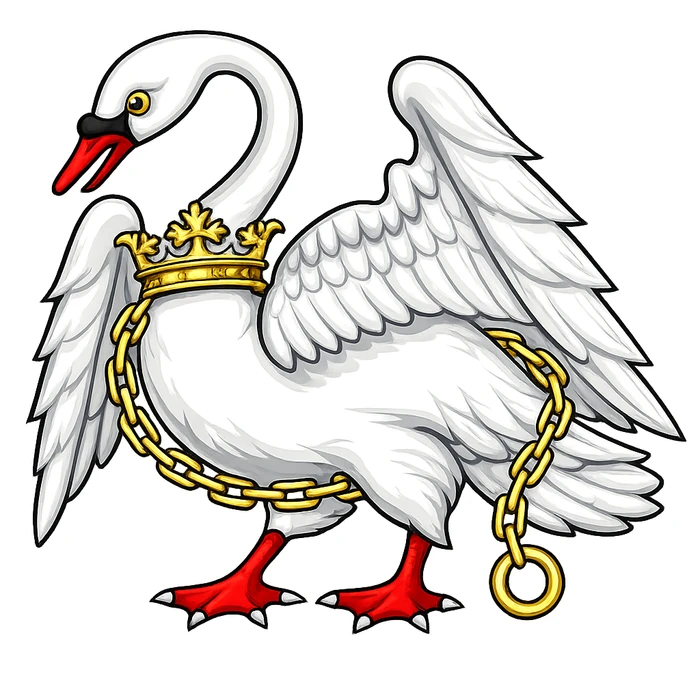
The family’s most famous badge was a swan, sometimes shown crowned or collared and chained, and its use as a de Bohun dynastic badge is well documented (Vincent, 2015). For Walton, the badge has exceptional significance. When Walton and Weybridge Urban District Council received arms in 1946, the crest used a swan’s head wearing a Saxon crown, and the contemporary explanation explicitly connected the swan both with the Thames and with the de Bohun family who had held Walton Manor until 1373 (Civic Heraldry of England and Wales, n.d.). The swan was not merely a generic riverside bird: it was a carefully chosen bridge between medieval manorial history and modern civic identity, arguably the most distinctively Waltonian emblem within the former civic arms.
Walton Leigh and the Mortimer inheritance
Walton-on-Thames contained more than one manor, and Walton Leigh followed a different line of descent from Walton Manor itself. Its overlordship passed through the Clare inheritance to the Mortimers, Earls of March: by 1422 “the manor was said to be held of Edmund Earl of March, who was grandson of Edmund Mortimer, Earl of March, lord of Clare in right of his wife Philippa” (Page, 1911). Through the Mortimer and Yorkist inheritance, Walton Leigh became connected with the dynastic line that produced Edward IV.
The Victoria County History illustrates the Mortimer arms alongside its account of Walton Leigh, blazoned barry Or and Azure, a chief Or with two pales between two gyrons Azure, and an inescutcheon Argent over all (Page, 1911): a shield of alternating gold and blue horizontal bands, with a gold upper section divided by two blue vertical stripes between blue corner triangles, and a plain silver shield placed over the centre of the whole design.
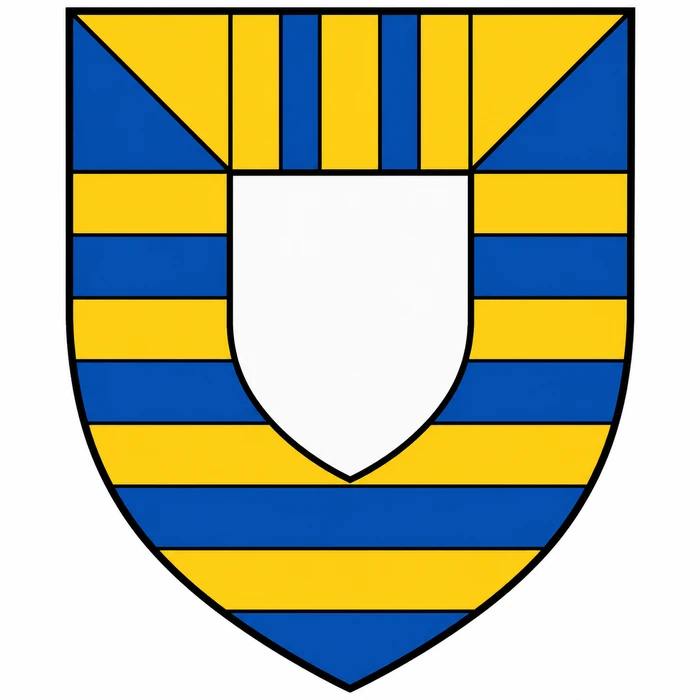
Their precise formal blazon matters less to the local story than their colours, which were deliberately reused in the 1946 Walton and Weybridge arms: the published explanation stated that gold and blue referred both to Surrey’s Warenne tradition and to the Mortimers who inherited Walton Leigh (Civic Heraldry of England and Wales, n.d.). It’s an unusually sophisticated piece of civic design, a single colour scheme carrying two levels of meaning at once: the county identity of Surrey, and the local manorial history of Walton Leigh.
Apps Court and the Agmondesham family
Apps Court, historically recorded in variant forms including Apse or Ebso, was another important Walton estate. The Victoria County History confirms that “in 1546 John Agmondesham died seised of the manor, which he had settled on his wife, who survived him,” and blazons his arms as Argent a chevron Azure between three boars’ heads Sable, three cinquefoils Or on the chevron (Page, 1911): a silver shield with a blue chevron between three black boars’ heads, the chevron itself charged with three gold five-petalled flowers. These arms have a direct, documentable Apps Court connection, making them among the strongest family arms associated with Walton-on-Thames. A separate Agmondesham line, seated at Randalls in Leatherhead, East Horsley and Barnes and extinct by 1588, is recorded with the same charges but five cinquefoils rather than three, on a brass at Ewell to a daughter of a John Agmondesham (Boumphrey, 1981a); whether that’s the same family’s arms recorded with a transcription variant, or a genuinely different differenced coat, isn’t established by the sources checked here.
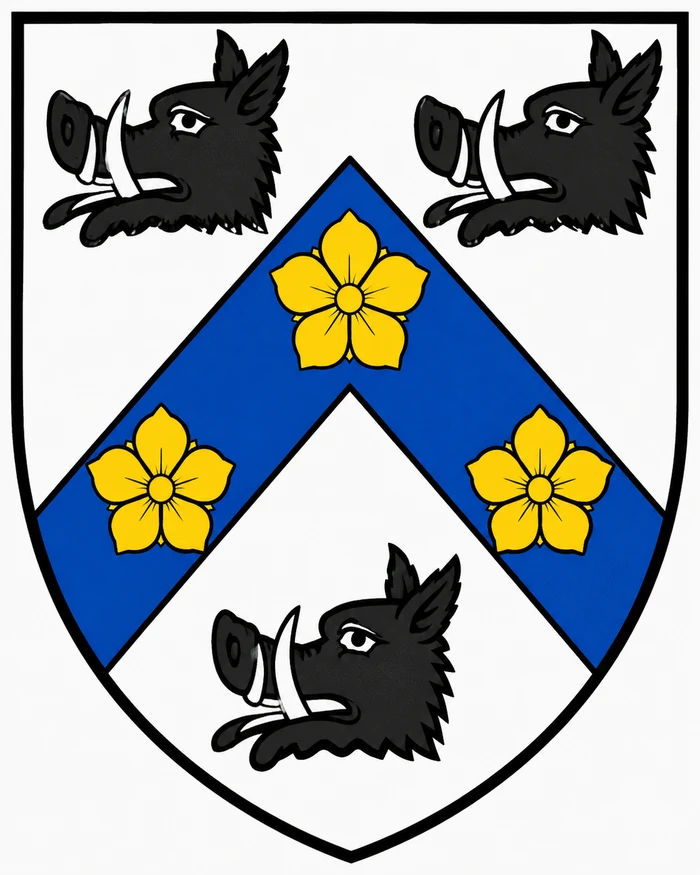
The 1946 civic explanation also referred to the historic joining of the manors of Walton, Walton Leigh and Apps Court under Tudor rule; the two Tudor roses in the council arms were intended in part to evoke that consolidation (Civic Heraldry of England and Wales, n.d.).
Ashley Park: Villiers, Fletcher and other armigerous owners
Ashley Park occupied a major place in Walton’s social and architectural history, and its owners brought several coats of arms into the town’s orbit. The Villiers family was associated with Ashley Park during the seventeenth century; Surrey Heritage records the arms of “Villiers of Ashley Park in Walton-on-Thames” as Argent, on a cross Gules five escallops Or, a silver shield bearing a red cross charged with five gold scallop shells, with a small annulet added for difference (Boumphrey, 1981b). The sources disagree about the annulet’s colour, with Surrey Heritage recording it as red against a black tincture in an older Burke tradition cited in the same entry; the underlying Villiers coat is secure, but that differencing detail shouldn’t be illustrated without choosing and citing a particular authority.
Sir Henry Fletcher acquired Ashley Park in 1786, and his memorial survives inside St Mary’s Church, an “aedicular pedimented plaque” the church’s own Grade I listing places on the north chancel wall alongside Matthew Kirby’s monument (Historic England, 1951). The Fletcher quarter of the family’s later, quartered achievement is recorded as Sable, a cross engrailed Argent between four plates, each charged with a pheon Sable: a black shield with a white, indent-edged cross, surrounded by four silver discs each carrying a black arrowhead (Boumphrey, 1981a). An earlier secondary description has sometimes reversed the main colours, and Surrey Heritage’s armorial catalogue should be followed unless the original grant or monument is examined directly.
The 1946 civic explanation described Ashley Park as one of two notable Tudor-associated buildings represented by the roses in the Walton and Weybridge shield, the other being Oatlands Palace. Ashley Park’s precise Tudor building fabric is a separate architectural question, but the designers of the civic arms clearly intended the roses to evoke the district’s Tudor history.
Hersham, Burwood Park and the Latton family
Hersham was historically part of the large parish of Walton-on-Thames, becoming a separate ecclesiastical parish only in 1851 (Page, 1911). That shared history explains why heraldry connected with Burwood Park belongs both to a Hersham study and to the wider historical parish of Walton. The Latton family owned Burwood before the Fredericks, and the Victoria County History records their arms as displayed in a window preserved from the old house: “Party Argent and Sable, a saltire Erminois and Ermine counterchanged,” a shield divided between silver and black, with a saltire of contrasting ermine patterns (Page, 1911). This is especially valuable evidence because it concerns heraldry once physically displayed at Burwood, rather than arms merely assigned to a surname in a later compilation. Whether the historic glass survives has not been established, and its fate is a priority question for any future survey of Burwood Park’s material history.
The Frederick family became the dominant heraldic association of Burwood Park; Surrey History Centre preserves a substantial collection of Frederick family deeds and papers, and Historic England lists the pyramid-shaped tomb of Sir John Frederick, who died in 1791, fifty yards south-east of St Mary’s Church (Historic England, 1984). The Frederick arms were Or, on a chief Azure three doves Argent: a gold shield with a blue band across the top carrying three silver doves, crested with another dove on a blue cap of dignity, and the motto Prudens simplicitas beat, “Prudent simplicity blesses” (Boumphrey, 1981a). The doves made the achievement unusually memorable, and quite different from the lions, eagles and crosses found elsewhere in Walton’s heraldic landscape. They should be understood as family arms associated with Burwood House and Park, not as the arms of Hersham itself: no separate civic arms for Hersham have been located anywhere in this research.
St Mary’s Church: Walton’s armorial archive
St Mary’s is the oldest surviving building in Walton-on-Thames and the most important location for studying the town’s personal and funerary heraldry. Historic England lists the church at Grade I, and its listing text independently confirms several of the monuments discussed here: the Roubiliac monument to Richard Boyle, Viscount Shannon, “erected 1755 by F.L. Roubiliac”; the brass to John Selwyn, who “died 1587”, shown with male and female figures and “11 children between”; the “Rodney Memorial” of 1774; the Fletcher plaque; and, on the north chancel wall, “Matthew Kirby. Died 1721, erected 1730… with cartouche shield” (Historic England, 1951). Not every monument is heraldic, and not every ornamental shield-shaped panel contains a coat of arms: a proper armorial survey has to inspect each object rather than infer heraldry from its shape.
Surrey Heritage’s armorial catalogue gives the arms from the Kirby monument (recorded there under the variant spelling Kirkbye) as Or, two chevrons Gules, on a canton Gules a mullet Or: a gold shield with two red chevrons, and a red square bearing a gold star in the upper corner (Boumphrey, 1981b). The listing itself also records a monument to “Mr. & Mrs. Christopher D’Oyley”, erected in 1821 by the sculptor Francis Chantrey (Historic England, 1951), a small spelling variant on the “D’Oyly” form used by local historian John Stonebanks, whose documentary history of the Cottimore and Walton Lodge estates records that Christopher D’Oyly inherited local estates and that Sarah D’Oyly later became sole owner of Cottimore and Walton Lodge (Stonebanks, 1982). The existence and importance of the monument is secure either way; the exact arms displayed on it, if any, should be confirmed through direct inspection or a high-resolution image before a blazon is published. Several other monuments, including further Boyle, Selwyn and later churchyard material, may also carry armorial devices that a systematic photographic survey, undertaken with the church’s permission, could properly catalogue for the first time.
Thomas Spong: a Walton grant waiting to be studied
One of the most promising discoveries for future research is an original grant of arms to Thomas Spong of Walton-on-Thames, dated 1824. Surrey History Centre’s own accessions record describes the item as including a painted shield of arms, though the publicly available catalogue summary doesn’t give the blazon or full grant text (Surrey History Centre, 2020). This is a direct personal grant tied explicitly to Walton-on-Thames, and it deserves more prominence than generic surname heraldry precisely because the archival document links a named armiger, a date, a place and a painted shield. Until the original has been inspected, this site won’t invent or reconstruct the design; the next research step is to obtain the archive reference and examine the grant itself.
Walton and Weybridge Urban District Council: Walton’s historic civic arms
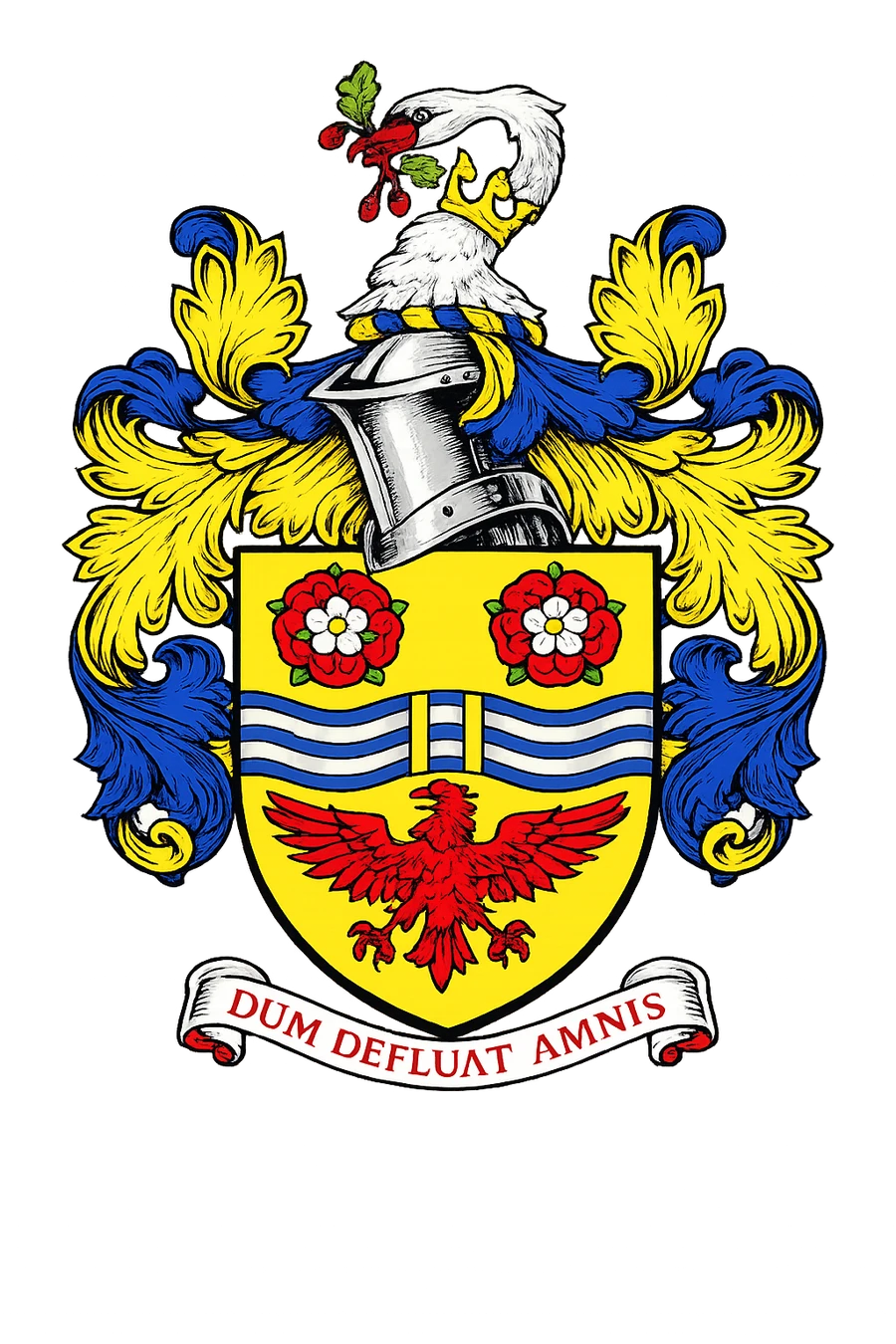
The most important formal civic achievement associated with Walton was granted to Walton and Weybridge Urban District Council on 29 March 1946 (Civic Heraldry of England and Wales, n.d.). The council had existed since 1933, when the former Walton and Weybridge urban districts were combined, so its arms represented the whole district rather than Walton alone, but many of their principal devices were selected specifically from Walton’s own geography and manorial history.
The shield had a gold field, crossed by a blue wavy band with two narrow silver waves, two Tudor roses above, and a red eagle below; two gold upright bars crossed the central water. The gold and blue came from Surrey’s heraldic tradition via the chequered arms of the Warenne Earls of Surrey, and also recalled the Mortimer family and Walton Leigh. The blue and silver waves represented the Thames. The Tudor roses referred to the district’s Tudor associations at Oatlands Palace and Ashley Park, and to the historic joining of Walton, Walton Leigh and Apps Court. The red eagle referred to the district’s supposed Roman associations, particularly the long-standing tradition linking Cowey Stakes with Julius Caesar’s crossing of the Thames, and the official explanation also suggested it could represent aeronautical research at Brooklands. That Caesar tradition needs handling carefully: Cowey Stakes are a genuine archaeological and historical feature, but their identification as Caesar’s crossing point is an antiquarian interpretation rather than established fact. The heraldry records the story’s importance to local identity, not proof that the crossing happened there. The two gold bars represented ancient bridges over the Mole and the Wey, and were also connected with successive Walton Bridges, combining the district’s name, its ancient river crossings and its modern transport history in a single device (Civic Heraldry of England and Wales, n.d.).
Above the shield, the crest showed a swan’s head wearing a gold Saxon crown and holding a sprig of oak. The swan represented the Thames and the de Bohun badge; the crown referred to the Saxon Hundred of Elmbridge; the oak linked the district with Surrey and with the Howard family, Earls of Surrey. The motto, Dum defluat amnis, “Till the river ceases to flow,” came from Horace, using the singular “river” (Civic Heraldry of England and Wales, n.d.).
This was not an arbitrary collection of attractive symbols: it was a compressed historical argument about place, connecting Surrey and the Warenne earls, Walton Leigh and the Mortimers, Walton Manor and the de Bohuns, the Thames, Tudor royal history, the Cowey Stakes tradition, Walton’s bridges, Brooklands and aviation, and the ancient Hundred of Elmbridge. Since no separate coat of arms for Walton itself has been located, the 1946 arms remain the clearest formal expression of Walton’s historic civic identity.
The arms of Elmbridge Borough Council
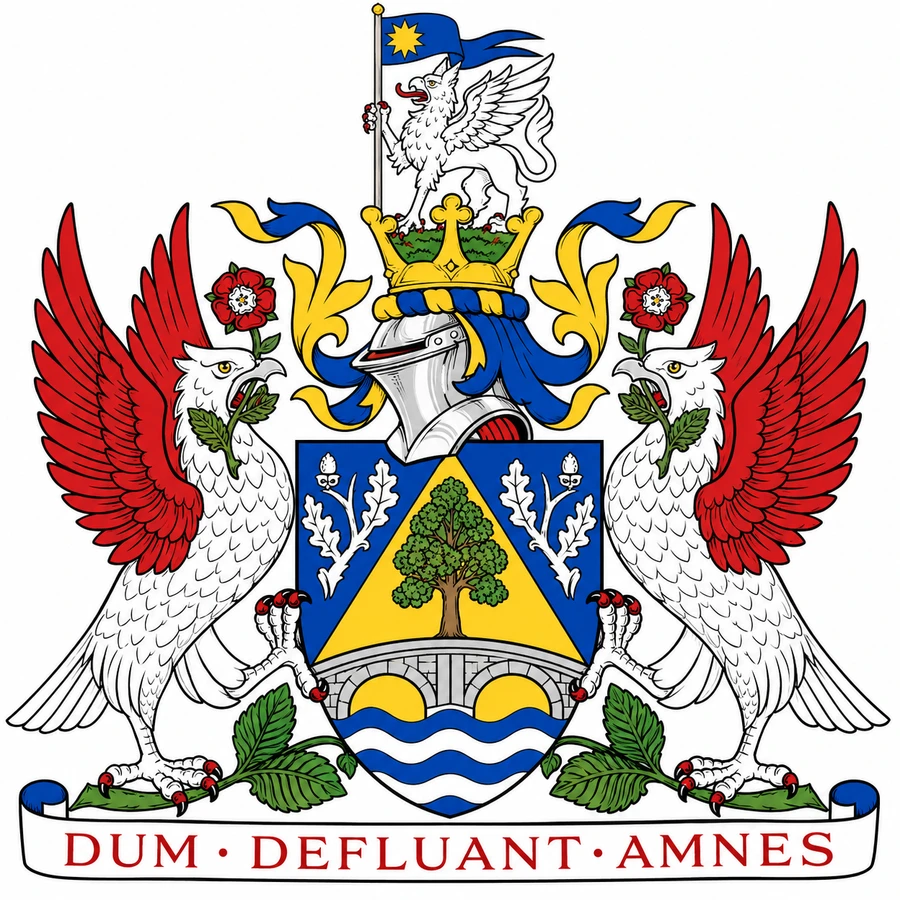
Walton and Weybridge Urban District Council was abolished in 1974, when its area was combined with Esher Urban District to form the Borough of Elmbridge. The new borough received arms on 10 August 1976 (Civic Heraldry of England and Wales, n.d.): not a complete break with the past, but a deliberate fusion of the heraldry of the two predecessor authorities.
The Elmbridge shield is blue, with a broad gold triangular form rising from the base, flanked by two silver oak sprigs; at the bottom are blue and silver waves, from which rises a two-arched bridge carrying an elm tree, a visual pun on the name Elmbridge: its two arches representing the two predecessor councils, Esher and Walton and Weybridge. The waves represent the Thames, Mole, Wey and Ember, and the oak sprigs identify both former authorities as Surrey bodies. The crest places a white griffin, taken from Esher’s arms, upon a grassy mound representing Esher Common, within a gold Saxon crown carried directly over from the Walton and Weybridge crest; the griffin supports a forked blue pennon carrying a nine-pointed gold star, one point for each of the borough’s nine civil parishes at the time of the grant. Two eagles support the shield, their white bodies from Esher’s arms and their raised red wings from Walton and Weybridge’s red eagle; each stands on a two-leaved elm sprig and holds a red-and-white Tudor rose in its beak, roses inherited directly from Walton and Weybridge. A simpler badge shows just the elm tree on its two-arched bridge over the waves. The motto, Dum defluant amnes, “Till the rivers cease to flow,” pluralised the former Walton and Weybridge motto to suit a borough shaped by four rivers rather than one (Civic Heraldry of England and Wales, n.d.).
The clearest inheritances from Walton and Weybridge are therefore the gold Saxon crown, the red wings of the eagle supporters, the Tudor roses, the blue-and-gold colour tradition, the river imagery, and the adapted Latin motto. Elmbridge’s arms can be read as the current continuation of Walton’s municipal heraldic tradition, even though they legally belong to Elmbridge Borough Council rather than to Walton itself.
Surrey heraldry: two designs, not one
Walton-on-Thames, Hersham and Whiteley Village are all in Surrey, and two different Surrey designs are easily confused. Surrey County Council’s current arms, granted on 20 September 1974 and replacing an earlier 1934 grant with a quite different design, are blazoned Per pale Azure and Sable two Keys in bend wards upwards and outwards bows interlaced Or between in dexter base a Woolpack and in sinister chief a Sprig of Oak fructed Argent (Wikipedia, n.d.). In plain English: a shield divided vertically into blue and black, with two interlaced gold keys, a silver woolpack, and a silver oak sprig. The keys refer to St Peter and the ancient Abbey of Chertsey; the woolpack recalls Surrey’s historic wool economy; the oak sprig represents rural Surrey. These are the corporate arms of the County Council, not a personal emblem belonging to every resident.
The Surrey flag is a different thing again: alternating gold and blue checks, derived from the arms of the de Warenne family, Earls of Surrey, and known as the Warenne Checks. The Flag Institute describes it as the community flag of the historic county, with medieval evidence for the design including its appearance at the Siege of Caerlaverock in 1300 (Flag Institute, n.d.). Gold and blue passed from this older county tradition into local civic heraldry, including both the 1946 Walton and Weybridge arms and the 1976 Elmbridge arms.
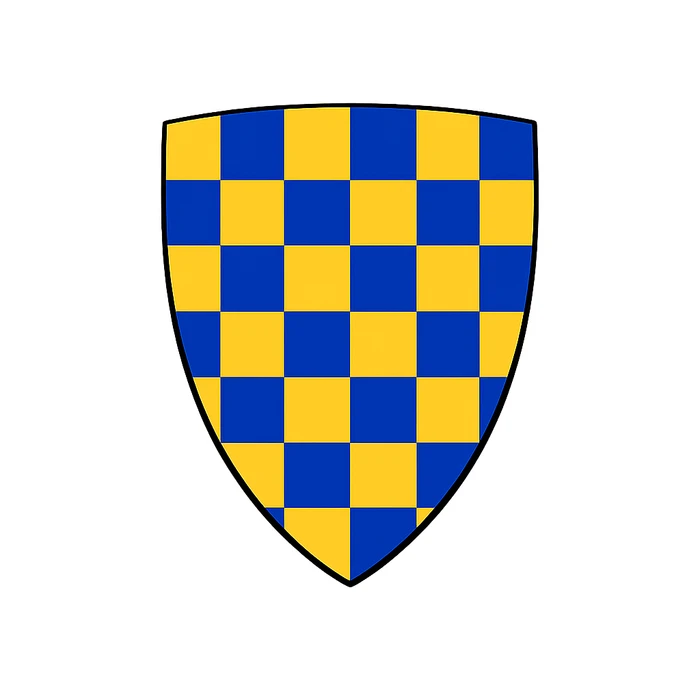
| Design | What it represents |
|---|---|
| Keys, woolpack and oak sprig | Surrey County Council as a corporate authority (granted 1974) |
| Gold and blue Warenne checks | The historic county and wider county identity |
Walton-on-Thames War Memorial: royal and national heraldry
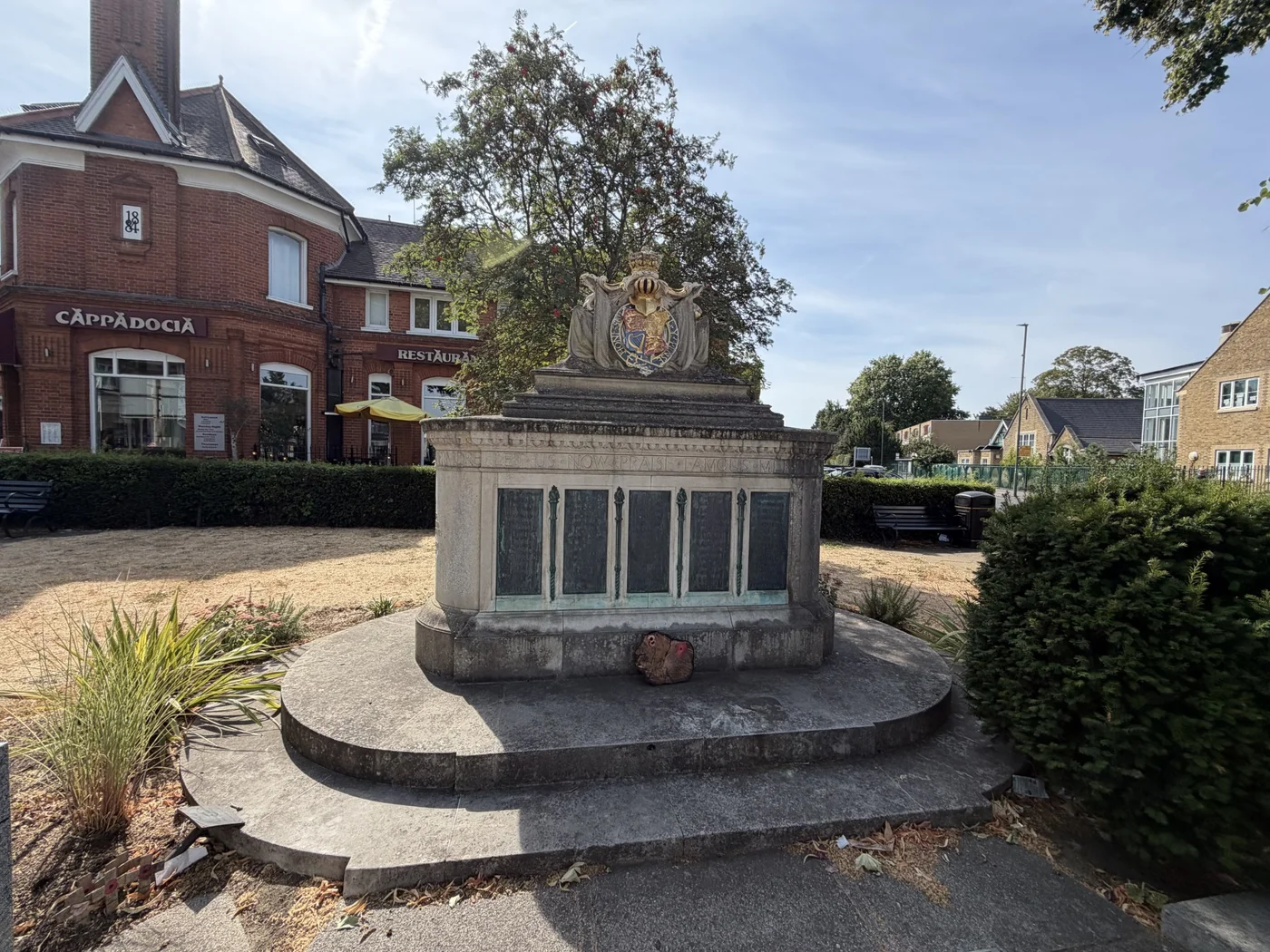
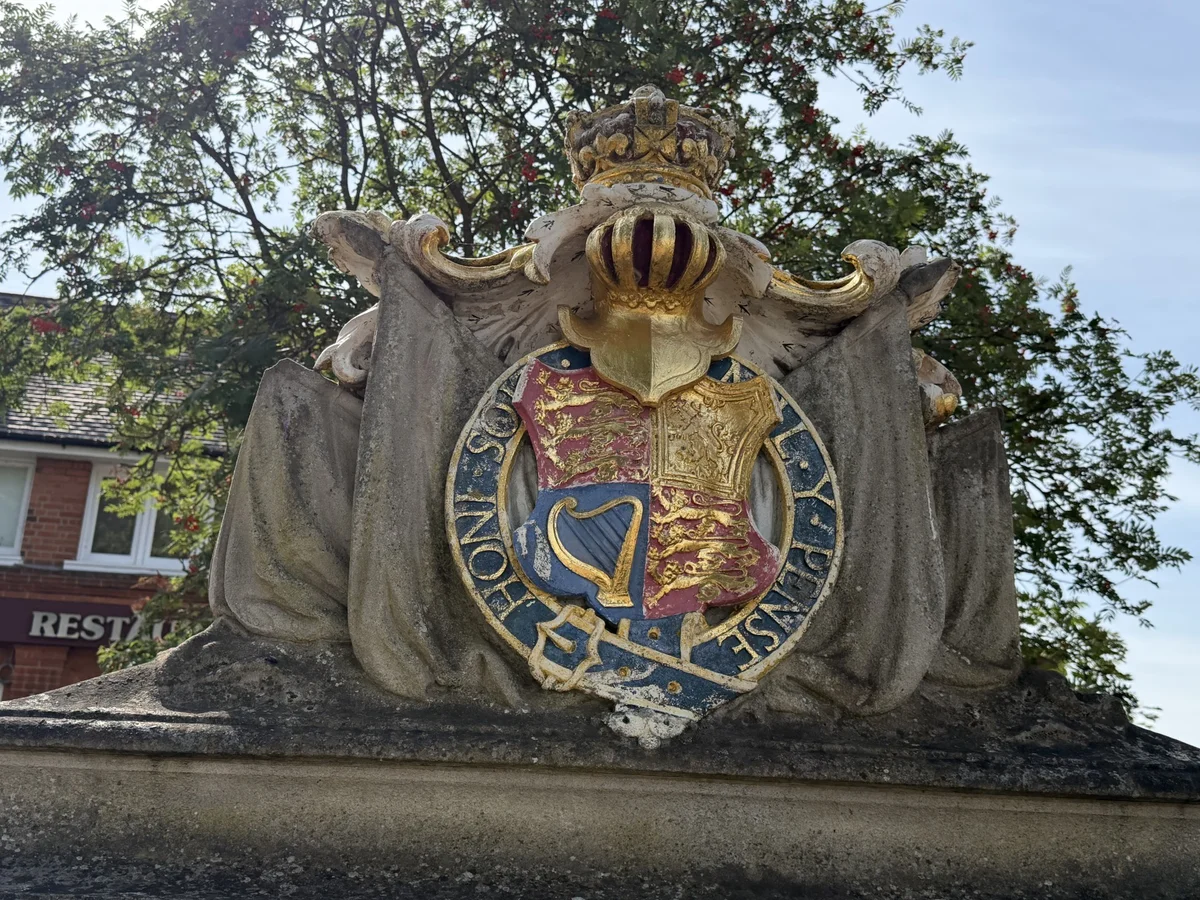
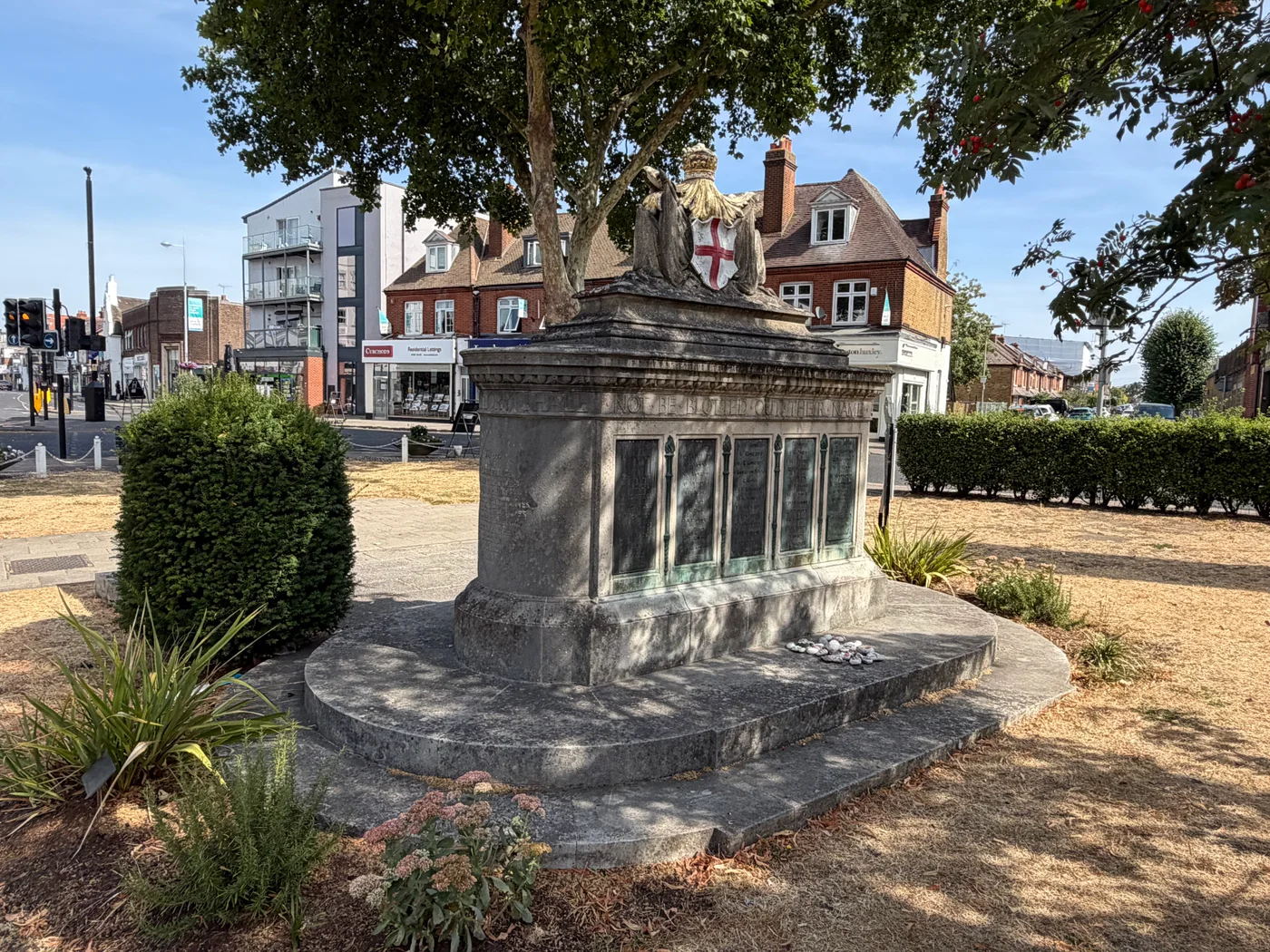
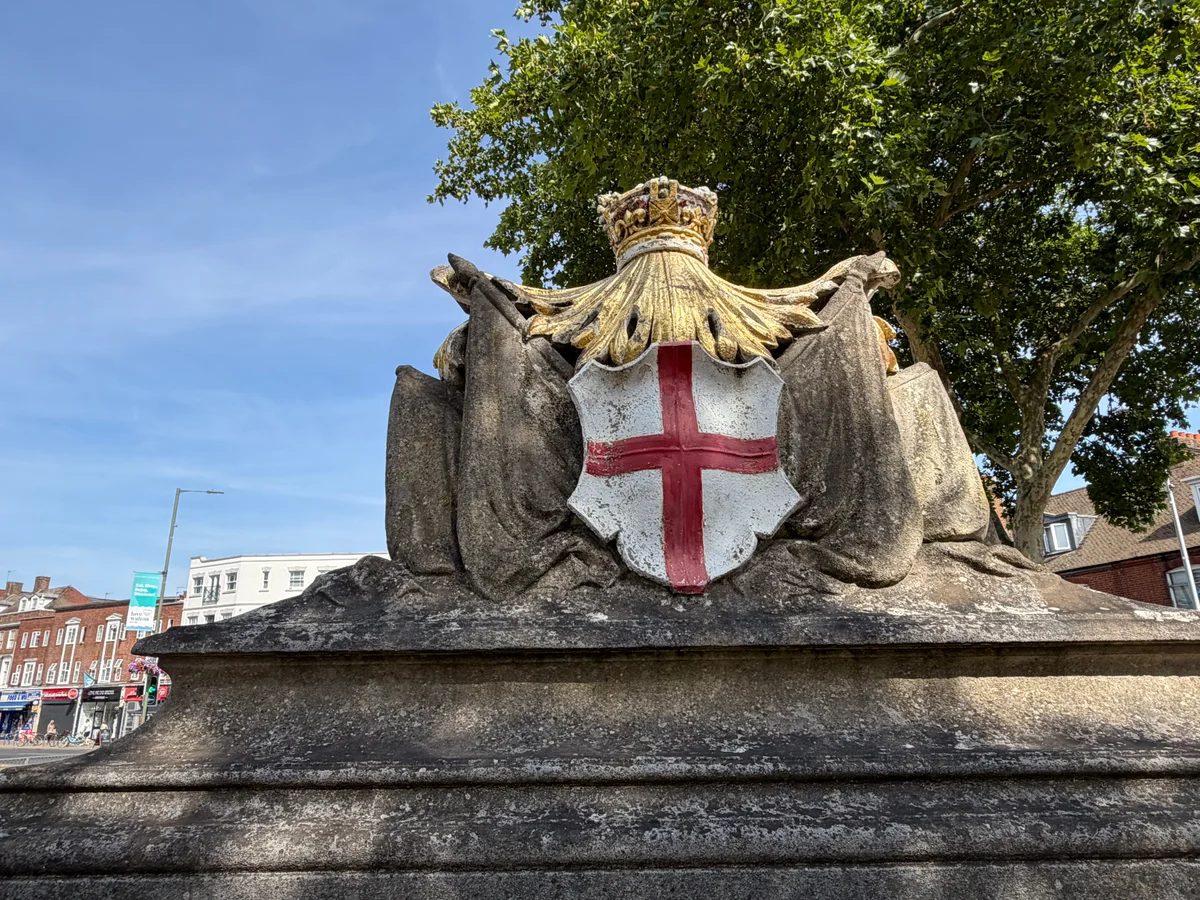
Walton’s most prominent public heraldic display stands above the war memorial in the Memorial Garden at the junction of the High Street, Ashley Road and New Zealand Avenue. It was unveiled by Lord Beatty on 8 July 1921, originally dedicated to 132 local servicemen who died in the First World War, with a general dedication for the Second World War added later; Historic England lists it at Grade II (Historic England, 2016). Its carved, painted and gilded summit carries two principal shields: on the front, the Royal Arms of the United Kingdom within the Garter, showing the three lions of England, the lion of Scotland and the harp of Ireland, surrounded by the Garter motto Honi soit qui mal y pense (“Shame on him who thinks evil of it”); and to the rear, a shield displaying the Cross of St George (blazoned simply Argent, a cross Gules), representing England, not Walton-on-Thames (Historic England, 2016). The achievement is a compressed representation: unlike the full national arms, it doesn’t include the usual lion and unicorn supporters.
The City of London and Trinity House on Walton’s riverside
Walton’s heraldic landscape extends beyond churches and council arms into the infrastructure of the Thames itself. Local historian John Stonebanks recorded several forms of riverside marker carrying institutional arms: nineteenth-century City of London boundary posts, marking the limits within which coal and wine duties were collected, including a granite post near the Walton and West Molesey parish boundary and a cast-iron post on the eastern approach to Walton Bridge; five further cast-iron stanchions bearing the City’s shield against the towpath boundary wall between the Backwater and Walton Wharf; and cast-iron Thames Conservancy boundary posts erected from around 1860, combining the shields of the City of London and Trinity House with the words “Conservators of the River Thames” (Stonebanks, 1980). The City of London shield, a white field bearing a red cross with the red sword of St Paul in the upper corner, records the City’s historic jurisdiction and fiscal interest along the Thames; it doesn’t represent Walton itself. Stonebanks’ account records what survived around 1980, and a modern field survey would be needed before asserting that every example he recorded still stands today.
Whiteley Village: a heraldic question, not a settled answer
Whiteley Village was created from William Whiteley’s charitable bequest. Trustees bought the roughly 225-acre site in 1911, and the first residents entered cottages during the First World War; the surviving trust history explains the village’s development, architecture and social purpose, but does not identify a formally granted coat of arms for the Village or Trust (Whiteley Homes Trust, 1949). No separate grant to Whiteley Village or Whiteley Homes Trust has been located in the sources reviewed for this article. That isn’t proof none exists, and a formal enquiry to the College of Arms, the definitive authority, would close the question.
St Mark’s Church, designed by Sir Walter Tapper and listed at Grade II, does carry heraldic-looking decoration: Historic England’s own listing records a “porch with decorative shields over the arch” (Historic England, 1984), which is as far as the official record goes. What’s established is that decorative shields exist as part of the church’s design. What remains unresolved is whether they’re coats of arms, attributed arms, religious symbols or purely decorative shields, whom they represent, and whether their colours or details have changed. A close photographic survey, compared against Tapper’s own drawings or the Whiteley Homes Trust archive, is needed before anyone identifies them with confidence.
A separate, related question concerns the Henry Lucas Cottages at Whiteley. The Henry Lucas Charity was historically connected with a seventeenth-century almshouse at Wokingham, where Historic England records a carved ornamental panel displaying arms and seventeenth-century armorial stained glass, with the Drapers’ Company inheriting the trusteeship in 1675 (Historic England, 1951). The charity’s assets were later transferred to Whiteley Homes Trust, creating the Henry Lucas accommodation at Whiteley Village, and secondary accounts report that the Lucas armorial design was copied for the Whiteley buildings. That’s plausible, but it shouldn’t be treated as fully verified until the armorial feature at the Whiteley cottages, the Drapers’ Company archive, or Whiteley Homes Trust’s own records describing the copied design have actually been examined. Until then, it’s best labelled reported and awaiting primary-source confirmation. No documented personal grant of arms to William Whiteley himself has been established in this research either; generic “Whiteley family crest” merchandise is not evidence of any connection to the founder or the village.
Myths and misunderstandings
A few claims about local heraldry circulate more confidently than the evidence supports. Walton-on-Thames has not always had its own town arms: no separate grant to Walton has been located, and the 1946 arms belonged to Walton and Weybridge Urban District Council, not to Walton alone. The Cross of St George on the war memorial is not Walton’s shield; it represents England, and the opposite face carries the Royal Arms. Azor did not have a coat of arms: he lived before hereditary heraldry developed in England, so any arms assigned to him would be retrospective invention. The Elmbridge arms do not belong to every resident; they’re corporate arms belonging to the borough council, not personal or family property. And a shared surname is not an entitlement: anyone named Frederick, Fletcher, Villiers or Whiteley cannot assume a right to use the corresponding arms, since English arms descend through authorised lines or belong to a specified corporate body.
The Cowey Stakes tradition deserves a more careful middle position than either “myth” or “fact”: the site is a genuine historic feature, but its identification as Julius Caesar’s crossing point is an antiquarian tradition rather than proven archaeology, even though the 1946 arms’ red eagle records how important that tradition was to local identity.
A timeline of local heraldry
| Date | Event |
|---|---|
| 1066 | Azor held Walton under Edward the Confessor, before hereditary heraldry existed |
| After 1066 | Walton passed to Edward of Salisbury |
| 12th century onward | Walton Manor entered the de Bohun inheritance through Maud and Humphrey de Bohun |
| 1373 | The de Bohun tenure of Walton Manor ended with the death of Humphrey de Bohun |
| 16th century | The Agmondesham family held Apps Court |
| 17th century | Villiers family heraldry became associated with Ashley Park |
| Late 17th-18th centuries | Latton arms were displayed at Burwood; the Frederick family later became associated with Burwood Park |
| 1721-1730 | Matthew Kirby died and his armorial monument was erected at St Mary’s |
| 1786 | Sir Henry Fletcher acquired Ashley Park |
| 1824 | A grant of arms was made to Thomas Spong of Walton-on-Thames |
| 1933 | Walton and Weybridge Urban District Council was formed |
| 29 March 1946 | Arms were granted to Walton and Weybridge Urban District Council |
| 1974 | Walton and Weybridge UDC and Esher UDC were replaced by Elmbridge Borough Council |
| 10 August 1976 | Arms were granted to Elmbridge Borough Council |
Where to see heraldry locally
The Royal Arms and the Cross of St George on Walton-on-Thames War Memorial, in the Memorial Garden at the junction of the High Street, Ashley Road and New Zealand Avenue, can both be viewed from public space. St Mary’s Church on Church Street holds monuments connected with Boyle, Selwyn, Fletcher, Kirby and D’Oyly, though access to the interior depends on the church’s own opening arrangements, and photography should be undertaken respectfully and with permission where required. The listed Frederick tomb stands in the churchyard, south-east of the church. Historic City of London and Thames Conservancy markers were recorded along the Thames towpath and Walton Bridge approaches by Stonebanks, though their present survival should be confirmed through a dedicated field survey. At St Mark’s Church in Whiteley Village, decorative shields are recorded above the south porch arch; any close photography should be from a lawful position and, where appropriate, with permission.
Why this heraldry matters
Heraldry can look like a decorative survival from an elite past. In Walton, Hersham and Whiteley Village it does something more useful: it reveals how successive communities understood their place. The de Bohun swan ties Walton to a family central to medieval English politics. Mortimer colours connect Walton Leigh with the Yorkist inheritance. The Agmondesham boars’ heads recall a Tudor manor at Apps Court. Villiers scallops and Fletcher arrowheads evoke Ashley Park. Frederick doves belong to the landscape of Burwood and Hersham. The 1946 arms transformed these fragments into a civic narrative: the Thames as the central wave, bridges crossing it, roses recalling Tudor history, a red eagle carrying Roman tradition and aviation, and above them all, the Bohun swan wearing the crown of the ancient Hundred. Elmbridge then reworked that inheritance, so that Walton’s crown, roses, colour and eagle survive within a new borough achievement built around an elm tree and a two-arched bridge.
The public heraldry adds other layers again. The Royal Arms and St George cross turn local wartime loss into national commemoration. City of London shields beside the river recall centuries of taxation and jurisdiction. Trinity House and Thames Conservancy emblems record the governance of navigation. And Whiteley’s unidentified shields are a reminder that some genuinely open questions are sitting in plain sight, waiting for someone to photograph and research them properly.
The swan’s local resonance hasn’t stopped at 1946, either. Walton & Hersham Football Club, formed in 1945 from the amalgamation of Walton FC and Hersham FC, plays today as “The Swans,” with a swan on its own club badge (Walton & Hersham FC, n.d.). Whether that choice was ever a deliberate nod to the Bohun tradition or arose independently, as a natural emblem for a riverside club, isn’t something the club’s own published history explains. Either way, it’s a reminder that the swan has kept resurfacing as a way for this town to picture itself, from a medieval earl’s badge to a modern football shirt.
Frequently asked questions
Does Walton-on-Thames have a coat of arms?
No separate formal grant to Walton-on-Thames has been located. The closest historic civic arms are those granted to Walton and Weybridge Urban District Council in 1946.
What did the Walton and Weybridge arms represent?
They represented the Thames, Surrey, Tudor history, Walton’s manors, local bridges, Roman tradition, Brooklands aviation and the de Bohun family’s swan badge.
Why is there a swan in Walton’s heraldic history?
The swan represented the River Thames and the de Bohun family, medieval lords of Walton Manor.
Does Hersham have a coat of arms?
No separate civic arms have been located. Hersham has strong family heraldry through Burwood Park, especially the Latton and Frederick families.
Does Whiteley Village have a coat of arms?
No formal grant to Whiteley Village or Whiteley Homes Trust has been located. Decorative shields survive at St Mark’s Church, but their identities require further research.
Are the arms on Walton’s War Memorial the arms of Walton?
No. They are the Royal Arms of the United Kingdom and the Cross of St George, both national rather than local heraldry.
Questions still to resolve
This account can’t be treated as final. A formal enquiry to the College of Arms would establish whether any grants, exemplifications or transfers exist for Walton-on-Thames Urban District Council before 1933, for a separate Walton town body, or for Hersham, Whiteley Village or Whiteley Homes Trust. The original 1946 and 1976 letters patent haven’t been examined directly, and would confirm the precise blazons, artists and grant context beyond what secondary accounts record. A proper armorial survey of St Mary’s, photographing and cataloguing every shield, hatchment, brass and stained-glass panel, remains to be done, as does direct inspection of the 1824 Thomas Spong grant at Surrey History Centre. The decorative shields at St Mark’s, Whiteley Village, need recording and comparing against Tapper’s own drawings and the Trust’s archive, and the reported Henry Lucas armorial copy at Whiteley needs checking against the original panel at Wokingham. Finally, nobody has yet established whether the historic window displaying the Latton arms at Burwood survives anywhere at all.
Sources
- Civic Heraldry of England and Wales (n.d.) 'Walton and Weybridge Urban District Council'. Available at: https://www.civicheraldry.co.uk/surrey_ob.html ↗ (Accessed: 2 August 2026).
- Civic Heraldry of England and Wales (n.d.) 'Elmbridge Borough Council'. Available at: https://www.civicheraldry.co.uk/south_east.html ↗ (Accessed: 2 August 2026).
- Historic England (1951) 'Church of St Mary, Church Street, Walton-on-Thames (List Entry 1030224)'. Available at: https://historicengland.org.uk/listing/the-list/list-entry/1030224 ↗ (Accessed: 2 August 2026).
- Historic England (2016) 'Walton-on-Thames War Memorial (List Entry 1432721)'. Available at: https://historicengland.org.uk/listing/the-list/list-entry/1432721 ↗ (Accessed: 2 August 2026).
- Historic England (1984) 'Church of St Mark, Octagon Road, Whiteley Village (List Entry 1377485)'. Available at: https://historicengland.org.uk/listing/the-list/list-entry/1377485 ↗ (Accessed: 2 August 2026).
- Historic England (1984) 'Fredericks Tomb, 50 yards south-east of Church of St Mary (List Entry 1377436)'. Available at: https://historicengland.org.uk/listing/the-list/list-entry/1377436 ↗ (Accessed: 2 August 2026).
- Historic England (1951) 'Henry Lucas Hospital and attached water pumps (List Entry 1303641)'. Available at: https://historicengland.org.uk/listing/the-list/list-entry/1303641 ↗ (Accessed: 2 August 2026).
- Page, W. (Ed.) (1911) 'Parishes: Walton on Thames, in A History of the County of Surrey, Vol. 3'. Available at: https://www.british-history.ac.uk/vch/surrey/vol3/pp467-475 ↗ (Accessed: 2 August 2026).
- Prosopography of Anglo-Saxon England (n.d.) 'Azur 2: Azur son of Thorth, fl. 1066'. Available at: https://pase.ac.uk/domesday/person/38807/ ↗ (Accessed: 2 August 2026).
- Flag Institute (n.d.) 'Surrey Flag'. Available at: https://www.flaginstitute.org/wp/flags/surrey-flag/ ↗ (Accessed: 2 August 2026).
- Wikipedia (n.d.) 'Surrey County Council (coat of arms, granted 1974)'. Available at: https://en.wikipedia.org/wiki/Surrey_County_Council ↗ (Accessed: 2 August 2026).
- Vincent, N. (2015) 'A Magna Carta Relic in Pennsylvania: Henry de Bohun, Earl of Hereford, and the Heraldry of Runnymede'. Available at: https://magnacartaresearch.org/read/feature_of_the_month/Apr_2015_2 ↗ (Accessed: 2 August 2026).
- Boumphrey, R. S. (1981) 'Surrey Coats of Arms: A-H'. Available at: https://www.surreycc.gov.uk/__data/assets/pdf_file/0006/36438/Surrey-Coats-of-Arms-A-H.pdf ↗ (Accessed: 2 August 2026).
- Boumphrey, R. S. (1981) 'Surrey Coats of Arms: I-Z'. Available at: https://www.surreycc.gov.uk/__data/assets/pdf_file/0007/36439/Surrey-Coats-of-Arms-I-Z.pdf ↗ (Accessed: 2 August 2026).
- Surrey History Centre (2020) 'Accessions 2020 (Thomas Spong grant of arms, 1824)'. Available at: https://www.surreycc.gov.uk/__data/assets/pdf_file/0014/272012/Surrey-History-Centre-accessions-2020.pdf ↗ (Accessed: 2 August 2026).
- Walton & Hersham FC (n.d.) 'Club History (1945 amalgamation of Walton FC and Hersham FC)'. Available at: https://waltonhershamfc.com/club/history/ ↗ (Accessed: 2 August 2026).
- College of Arms (n.d.) 'Granting of Arms'. Available at: https://www.college-of-arms.gov.uk/services/granting-arms ↗ (Accessed: 2 August 2026).