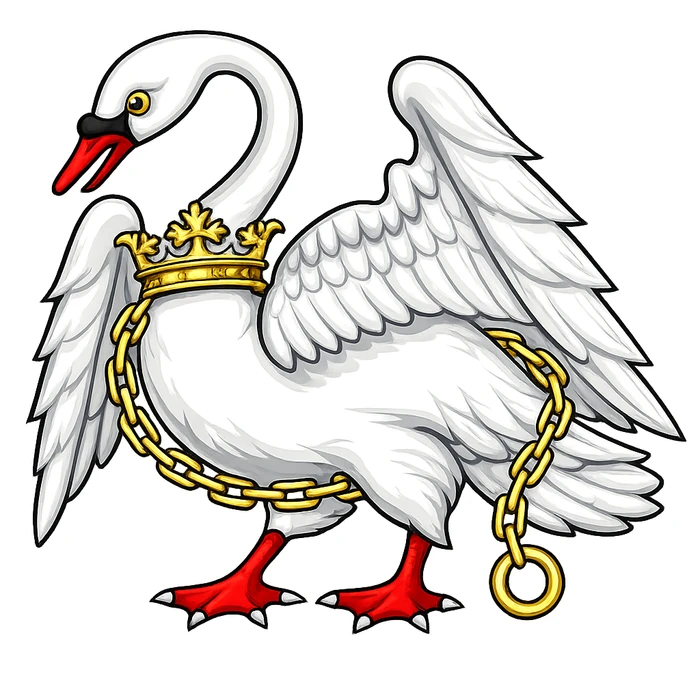
At Walton Wharf, swans are part of the everyday life of the river. They gather beside the boats, glide past the towpath and are among the most familiar sights on this stretch of the Thames. Yet the swan is also a recurring symbol in Walton’s history. It appears on the seal of a medieval nobleman connected with the manor, on a Victorian regatta trophy, in the coat of arms of the former urban district council, and in the badge and nickname of our beloved local football club, Walton & Hersham.
It would be tempting to present the swan as a symbol whose use stretches continuously from the Middle Ages to the present day. The historical record does not support that conclusion. What the evidence reveals is something more complex: a series of separate moments in Walton’s history when the swan was chosen, adapted or rediscovered as a symbol of our community.
The earliest takes us to 1301, when the de Bohun family held Walton Manor and one of its most powerful members pressed a swan into the wax of his seal. More than five and a half centuries later, a silver goblet hallmarked in 1864 carried a swan and a pair of crossed oars inside a roundel lettered for the Walton-on-Thames Regatta. In 1946 the bird entered formal civic heraldry when a crowned swan’s head became the crest of Walton and Weybridge Urban District Council. In the modern period it has appeared in school, sporting, motoring and community identities.
A swan above the shield
The first firm date in the story is 12 February 1301. On that day, English barons wrote to Pope Boniface VIII to reject papal intervention in Edward I’s claims over Scotland. The document now known as the Barons’ Letter survives at The National Archives, together with the seals of its signatories (The National Archives, 1301).

Among them was Humphrey de Bohun, fourth Earl of Hereford and earl of Essex, and Constable of England. He was then about twenty-five, and had not long since inherited the earldoms and the constableship, one of the great hereditary offices of the crown, from his father. The following year he married Elizabeth, a daughter of the very king whose Scottish claims the letter defended, surrendering his lands to the crown on the occasion and receiving them back in tail. His relationship with Edward II later broke down. In 1310 he was named one of the twenty-one Ordainers appointed to reform the king’s government and household, and in 1312 he took up arms with the baronial opposition to Piers Gaveston. Yet he still fought in the Scottish campaign of 1314 and was captured after Bannockburn. He later opposed the Despensers and in March 1322 was killed at Boroughbridge, after which he was buried in the church of the Friars Preachers at York (Thompson, 1886).
His counter-seal displays the de Bohun shield hanging by its guige, the strap by which a shield is slung, from a swan standing above it. The bird is unmistakably part of his personal and dynastic imagery, and modern scholarship identifies this as the earliest securely dated appearance of the swan among the surviving heraldic devices used by the de Bohun earls (Diaz Pascual, 2020).

The distinction between the shield and the swan matters, and so does the word for it. The de Bohun coat of arms was not a swan: its best-known form was a blue shield crossed by a broad silver diagonal band, narrowly bordered in gold, between six gold lions. Nor, strictly, is the bird on this seal a crest. A crest is the device borne above the helmet in a full achievement, and no helmet appears here. The swan stands above the escutcheon and carries the guige from which the shield is suspended, giving it something of a supporter’s visual role in this composition. The swan itself was a de Bohun badge, a separate dynastic emblem used far more flexibly than arms on seals, jewellery, clothing, manuscripts, buildings and the equipment of retainers. One bird could occupy several heraldic roles in different settings, and in 1946 this one would return to Walton as a true crest.

In medieval society such badges were potent signs of identity and allegiance. Arms followed formal rules and primarily identified a lineage; badges could be shared. Worn by followers or attached to possessions, they made noble affinity visible across a crowd. Laurent Hablot’s study of the chained swan places it within the developing emblematic culture of the later Middle Ages, when a princely device could express lineage, personal identity, chivalric aspiration and political loyalty all at once (Hablot, 2001).
The 1301 seal proves that Humphrey de Bohun used a swan. Its significance for Walton comes from landholding. The de Bohuns were then lords of Walton Manor, which had entered the family through the marriage of Maud, daughter of Edward of Salisbury, to an earlier Humphrey de Bohun, and it remained in de Bohun hands until the death of the last male earl in 1373 (Page, 1911). A family holding Walton Manor was demonstrably using the swan more than seven centuries ago.
Why did the de Bohuns choose a swan?
Two explanations for the swan’s origin have long competed, and may even have reinforced one another.
The first is a play on a name. The de Bohuns acquired the earldom of Essex through the Mandeville inheritance. In a catalogue of heraldic badges published in 1907, Arthur Charles Fox-Davies repeated an antiquarian explanation, attributed to James Robinson Planché, that the swan had come from the Mandevilles, who were said to descend from an ancestor called Adam Fitz-Swanne (Fox-Davies, 1907). Hablot likewise records the supposed descent from Adam Fitz Swanne, son of a Swanne or Swanus, within the genealogy later used to explain the emblem (Hablot, 2001).
The name invites wordplay. Swanne or Swanus has been associated with the Scandinavian personal name Sweyn or Sveinn. If this family connection is correct, the swan may have been chosen as a visual play on the family name, a common feature of medieval heraldry.
It is an attractive explanation and it is not established fact. Planché was both a dramatist and a serious antiquary. He wrote extensively for the stage, helped pioneer historically researched theatrical costume, became a fellow of the Society of Antiquaries in 1829, and later served at the College of Arms as Rouge Croix Pursuivant and Somerset Herald (Boase, 1896). His 1871 study of the genealogy and armorial bearings of the earls of Hereford was part of a sustained attempt to correct inherited errors in medieval pedigrees (Planché, 1871). That scholarly standing deserves recognition, but it does not turn the reported descent from Adam Fitz-Swanne into a demonstrated fact. No contemporary evidence cited here securely establishes that genealogy or proves that it caused the de Bohuns to adopt the bird. Modern analysis instead emphasises that de Bohun heraldic language developed over time, with individual earls selecting devices to express ancestry, alliances and family memory (Diaz Pascual, 2020).
The second explanation leads into romance. Across Europe, noble families associated themselves with the legend of the Knight of the Swan, a mysterious warrior who arrived in a boat drawn by a swan, a story that became attached to the legendary ancestry of Godfrey of Bouillon, a leader of the First Crusade. By claiming a place in that imaginative genealogy, a noble house could present itself as ancient, chivalric and touched by sacred history (Wagner, 1959).
The swan’s appeal was therefore not simply visual. It belonged to a world of courtly romance, crusading memory and aristocratic self-fashioning. Museum collections preserve small lead-alloy badges shaped as chained swans, evidence that the emblem moved beyond manuscripts and seals onto objects worn on the body. The London Museum interprets its chained-swan example as a Bohun livery badge that declared allegiance and evoked descent from the legendary Swan Knight (London Museum, n.d.).
The two explanations need not cancel each other out. A name resembling “swan” may have made the bird a convincing ancestral pun, while the Swan Knight legend gave it chivalric glamour. Medieval symbols tended to accumulate meanings rather than obey a single origin story.
From the de Bohuns to the House of Lancaster
The senior male line ended when Humphrey de Bohun, Earl of Hereford, Essex and Northampton, died in 1373, leaving his estates and dynastic inheritance to his daughters Eleanor and Mary. Around 1380 Mary married Henry Bolingbroke, and through that marriage the swan entered the emblematic world of the House of Lancaster (Given-Wilson, 2016, pp. 26-27; British Museum, n.d.; Wagner, 1959).
Mary did not live to see what her inheritance became. She died in 1394, in childbirth, at about twenty-five, and was buried at Leicester (Given-Wilson, 2016, p. 86; Tout, 1891). Her husband took the throne from Richard II five years later and reigned as Henry IV; one of the sons she left behind became Henry V (Tout, 1891). The woman who carried the swan into the royal house was never queen of it.
One of the finest surviving objects from this tradition is the Dunstable Swan Jewel in the British Museum. Made in about 1400, it is a tiny gold livery badge covered in white enamel, with black enamel for the eyes and a gold collar and chain. Its delicacy should not disguise its purpose: a badge this costly proclaimed attachment to a great household and made loyalty visible (British Museum, n.d.).

The emblem continued into her son’s reign. At Westminster Abbey, the vault and bridges above Henry V’s tomb carry several of his devices, including a collared swan chained to a beacon (Westminster Abbey, n.d.). The bird that had hung above a shield on a baron’s seal in 1301 had become part of royal display.
This wider history explains why the swan was such a resonant emblem for later heralds: it connected Walton’s medieval manor with one of England’s great baronial families and, through Mary, with the Lancastrian monarchy. It is not evidence of a medieval Walton identity, and after the de Bohun seal the local trail goes quiet for nearly six centuries. No sequence of Walton objects, seals or institutional records carrying the bird has yet been identified from that long interval. When the swan next appears in this story it is not in a medieval archive at all, but in Victorian sport.
The Victorian regatta swan
Walton Amateur Regatta was established in 1862, and its successor, the Walton and Weybridge Regatta, still races on the Thames at Walton over a course beginning below Walton Marina and finishing downstream near Walton Rowing Club (Weybridge Rowing Club, n.d.; Walton and Weybridge Regatta, n.d.).
Two silver prizes from the regatta survive in photographs, and only one of them is dated.
The dated one is a goblet. An auction record describes a “Walton on Thames Regatta” trophy, hallmarked in London in 1864 and marked by the maker EM/JM, standing 19.5cm high and weighing 10.4oz, with a crest above a branch column and a gentleman standing with an oar (Invaluable, n.d.). The photograph shows what that crest is: an applied cartouche mounted on the bowl, carrying a swan within a roundel lettered WALTON ON THAMES REGATTA, with a pair of oars crossed behind it (Bishop and Miller Auctioneers, n.d.). The hallmark dates the assay of the goblet. It does not, on its own, show when the cartouche was made or fixed to the bowl, and this article cites no condition report or specialist examination of the joins, so the hallmark does not date the swan.

The second object is a plain silver jug, which reached this article from an unconnected source, carrying the same device engraved into the body rather than applied to it (Walton-on-Thames.org, n.d.). No hallmark has been read from those photographs, so the jug is not dated here; the 1864 mark belongs to the goblet.


The jug’s engraving settles a different question. Beneath the words LOCAL GIGS, and above the roundel, it records that the prize was won by E. R. Kennedy and F. A. Stringer, with A. Payne as cox (Walton-on-Thames.org, n.d.). This was not commemorative silver but a trophy actually competed for and awarded, in a named event, to a named crew. What it does not give is a year, and the crew’s own careers on the water have not been traced.
Two objects change the reading of one. A single trophy shows only what one silversmith, or one commissioning committee, thought suitable for a Walton regatta prize on a single occasion. The same device on a second trophy of quite different manufacture, cast and applied on the goblet and cut into the body of the jug, points to something more settled: a badge the regatta used, rather than an ornament chosen once and forgotten. The two agree independently. They are not a matched pair from one collection: the goblet is known from a saleroom record, the jug came to this article from an unrelated source, and neither was found by looking for the other. On this evidence the swan in its lettered roundel was not decoration applied to a Walton prize. It was the regatta’s own emblem, and by 1864 it was already in use.
The device is simple and eloquent. The oars identify the competition. The swan locates it on the Thames. Nothing about it requires knowledge of medieval genealogy. On a silver cup above two oars, the bird simply announced the river.
The period is strikingly early in the development of mass leisure on the Thames. The railway had reached Walton in 1838, putting the town within easy reach of London, but the great boom in river recreation was still years away (Network Rail, 2024). The period now remembered as the golden age of the river, when boat outings, steam-launch trips, houseboat holidays, fairs, picnics and carnivals drew enormous crowds, rose most sharply between 1879 and 1887. By 1889 some 12,000 pleasure boats, 300 steamers and around 150 houseboats were registered on the water (Wenham, 2018). Walton’s regatta was established a generation before that.
The goblet cannot yet settle whether the swan was a regatta device before the council’s grant of arms in 1946. Its hallmark dates the silver to 1864, but not the applied cartouche that carries the swan, so that question stays open until the cartouche itself can be dated. The design turns the medieval bird of dynastic identity into an immediately understandable riverside image: a swan, a pair of oars and Walton’s name.
Why the swan belongs so naturally to the Thames
The river alone is enough to explain why a Victorian designer might reach for a swan. Mute swans have held a distinctive place in the legal, ceremonial and visual culture of the Thames for centuries. The Crown’s right to claim unmarked mute swans in open water dates back to the twelfth century, when the birds were valuable food and status objects, and rights were also granted to others, including the Vintners’ and Dyers’ livery companies. Swan Upping survives today as a conservation and education exercise, with cygnets checked, measured and ringed during the annual journey upriver (The Royal Household, n.d.).
It is easy to overstate this as the monarch owning every swan in Britain. The more accurate position is that the Crown retains the right to claim unmarked mute swans in open water, and exercises that prerogative principally on certain stretches of the Thames. The ceremony belongs to the same river culture as Walton’s regatta, though there is no evidence that it inspired the 1864 engraving.
The Thames gave Walton’s swan an immediate meaning that needed no heraldic learning. The de Bohun connection gave it historical depth. In 1946 the two were finally joined in writing.
1946: the swan enters civic heraldry
Walton and Weybridge Urban District Council was created in 1933 from the former Walton-on-Thames and Weybridge urban districts, and on 29 March 1946 it received a formal grant of arms (Civic Heraldry of England and Wales, n.d.b).
The shield was a compressed history of the whole district: gold and blue for Surrey and for the Mortimers who inherited Walton Leigh, blue and silver waves for the Thames, two Tudor roses for Oatlands and Ashley Park and the joining of Walton, Walton Leigh and Apps Court, a red eagle for Roman tradition and for aeronautical research at Brooklands, and two upright bars for ancient bridges over the Mole and Wey and for successive Walton Bridges. Each element is examined in turn in the article on the heraldry of Walton-on-Thames, Hersham and Whiteley Village.
Above that crowded shield rose the memorable part: a swan’s head, naturally coloured, wearing a gold Saxon crown and holding a sprig of oak in its beak. The account reproduced by Civic Heraldry joins the two principal strands of this story explicitly. The swan alluded both to the River Thames and to the de Bohun family, lords of Walton Manor until 1373. The Saxon crown and the oak also appeared in the arms of Surrey and linked the district with the county, while the oak additionally recalled the Howard family, Earls of Surrey (Civic Heraldry of England and Wales, n.d.b). When the Saxon crown was retained in the arms granted to Elmbridge in 1976, the later published explanation associated it with the historic Hundred of Elmbridge (Civic Heraldry of England and Wales, n.d.a).
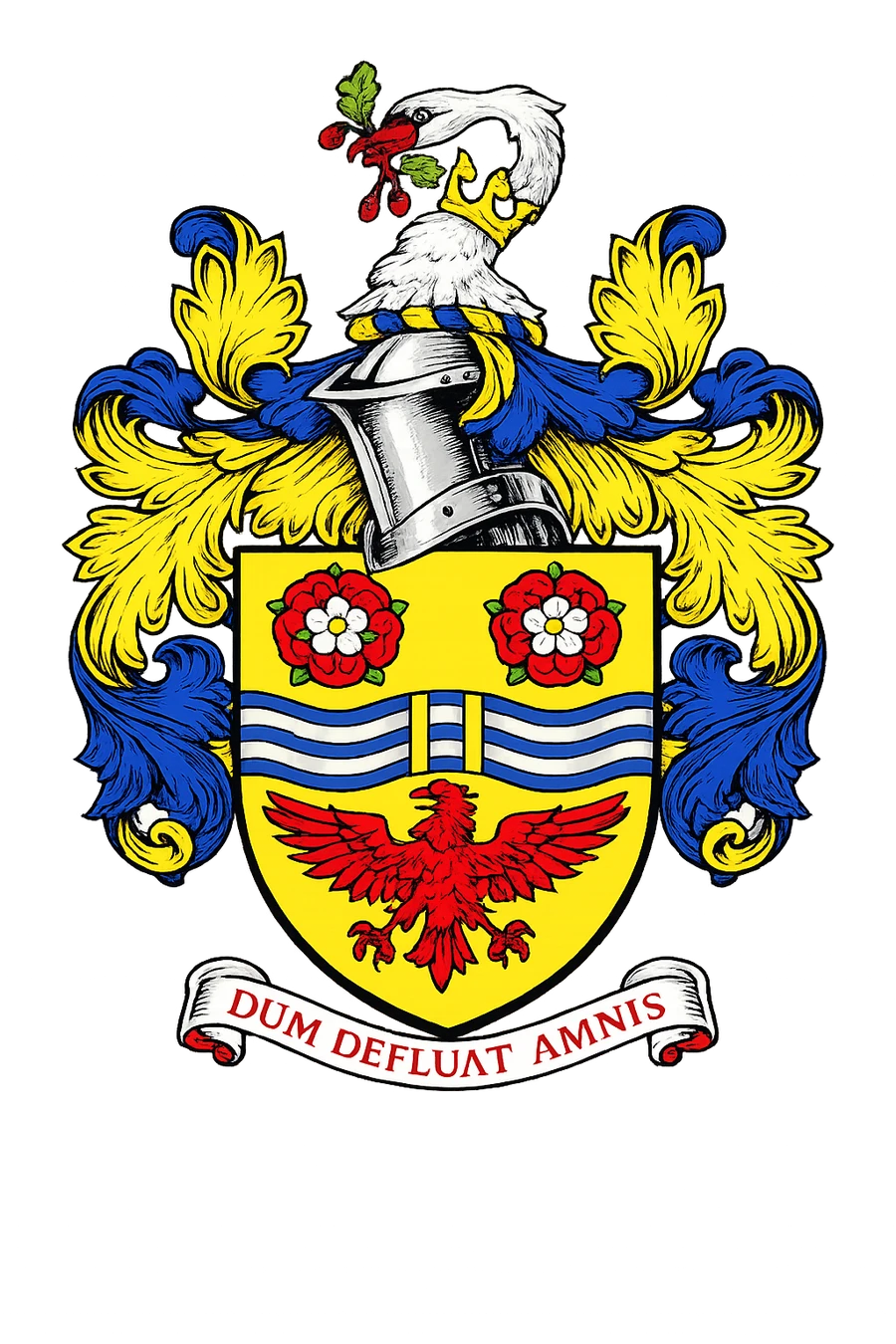
The crest did something the Victorian trophy had never needed to do: it placed the medieval and riverside meanings together in a formal civic achievement. The bird could still be read instantly as a creature of the Thames, but anyone who knew the district’s manorial history could now also recognise the badge of the de Bohuns.
The motto pressed the river theme further. Dum defluat amnis, rendered in the published account as “Till the river ceases to flow”, is adapted from Horace’s Epistles and suggests constancy rooted in place. The council had chosen not simply a bird but an argument: that the district’s identity was carried by the Thames, connected to medieval lordship and capable of enduring as long as the water itself.
One point of naming matters. No separate coat of arms for the town of Walton-on-Thames has been identified in the sources examined here. The 1946 achievement is the clearest historic expression of Walton’s civic heraldry, but it belonged to Walton and Weybridge Urban District Council.
What survived after the council disappeared?
The council ceased to exist in 1974, when its area was combined with Esher Urban District to form the Borough of Elmbridge. Elmbridge received its own arms on 10 August 1976, retaining several elements from Walton and Weybridge, including the gold Saxon crown, Tudor roses, river imagery, gold and blue colouring and the red wings of the eagle supporters. Its motto adapted the old singular into the plural: Dum defluant amnes, “Till the rivers cease to flow” (Civic Heraldry of England and Wales, n.d.a).
The swan did not make the journey. Its use as the crest of a functioning local authority lasted from 1946 to 1974. By then, though, it had taken root somewhere councils could not reach.
Rydens School: a civic echo
The swan also entered the visual life of local education. Rydens School traces its beginnings to 1954. A surviving school newsletter shows that its later badge prominently combined a swan with a red eagle (Rydens School, 2010; Surrey Live, 2013).

The pairing is significant. Both birds appeared in the 1946 arms of Walton and Weybridge: the crowned swan’s head as the crest and the red eagle on the shield (Civic Heraldry of England and Wales, n.d.b). The close resemblance makes it plausible that Rydens adapted elements of the council achievement. No school record located for this article, however, states who designed the badge, when it was adopted or what it was intended to represent. The badge therefore establishes the use of the two birds by the school, not that it had used them since opening in 1954 or that the council arms were their documented source.
HWM: from heathcock to swan
Hersham and Walton Motors, better known as HWM, carried Walton’s name onto racing circuits across Britain and continental Europe during the early postwar years. Its original badge, however, did not contain a swan (HWM, n.d.; Taylor, 2019).
The bird at the centre of the earliest HWM badge was a heathcock, an old name for the male black grouse. It came from the heraldry of founder John Heath’s family rather than from Walton itself. The recorded arms of John Benjamin Heath, 1st Baron Heath, contain the same arrangement seen on the badge: a shield divided by a chevron, two pierced stars above and a heathcock below. A biography of the racing driver John Heath also records that he used the family’s heathcock as the emblem of his HWM racing cars (Morris and Oldfield, n.d.; Motorsport Memorial, n.d.; Taylor, 2019, p. 129).
A white swan appeared on a later form of the HWM badge, replacing the black grouse (Taylor, 2019, p. 129). The evidence consulted has not established precisely when the change was made or why. HWM’s location at Walton, close to the Thames, makes a connection with the town and river plausible, but this remains an interpretation rather than a documented explanation.
HWM’s changing badge tells a subtler story: the business began with a bird representing its founder’s family and later adopted one increasingly associated with the place it called home.
The Swans of Walton
Walton & Hersham Football Club carries the bird in its visual identity and is known as the Swans. Formed in 1945 through the amalgamation of Walton FC and Hersham FC, the club’s own history uses the nickname in its account of the 1950-51 season, showing that it was established by the early postwar years even though its precise adoption date remains unknown (Walton & Hersham FC, n.d.).
The club’s badge makes the amalgamation visible. The swan stands for Walton and a robin for Hersham, the two birds set above the waves of the Thames with the 1945 foundation date beneath. The swan, in other words, is not simply the club’s emblem but the Walton half of a merger recorded in heraldic shorthand.
Walton Athletic Club, founded in 1942, tells a similar story. Its present badge combines the club’s name and foundation date with a white swan (Walton Athletic Club, n.d.).
Neither foundation date should be read as a date of adoption. Walton AC’s founding in 1942 does not establish that its swan predates the 1946 civic grant, and no source located for this article records when either club first took up the bird, who designed it, or what reason was given at the time. Club minutes, early letterheads, programmes, photographs or kit may eventually settle it.
The swan appeared in Walton’s commercial life too. Walton Business Group, co-founded in 2005 by Sarah-Jane Shellard, used the bird in its logo. Shellard passed away in 2014 after nearly a decade as a director. The company later changed its name to Walton, Weybridge & District Business Group Limited and was dissolved in 2023 (Brooklands Radio, 2015; Companies House, n.d.; Funeral Notices, 2014; Walton Business Group, n.d.). Its logo does not make the swan an official town device, but it shows how readily the bird could function as shared local shorthand.
The uncertainty is itself revealing. By the time these badges became familiar, the swan no longer needed an origin story. It had become visual shorthand for Walton.
What the evidence proves, and what it does not
The surviving evidence offers several different levels of certainty:
| Date | Evidence | What it establishes | What it does not establish |
|---|---|---|---|
| 1301 | Humphrey de Bohun’s counter-seal | A de Bohun lord of Walton used the swan badge | That Walton itself had adopted a swan emblem |
| 1864 | The Walton-on-Thames Regatta goblet, hallmarked and auction-catalogued, its swan on an applied cartouche | A silver goblet assayed in London in 1864 now carries the swan device | When the cartouche was made or attached, and so whether the device was in use by 1864; that it was Walton’s first use, or that the regatta ever formally adopted the device |
| Undated | The Walton-on-Thames Regatta jug, carrying the same device engraved, with LOCAL GIGS and the winning crew | The device recurs across prizes of different manufacture, and was used on a trophy actually competed for and awarded | When the jug was made, or which year’s regatta it belongs to |
| 1946 | Grant to Walton and Weybridge Urban District Council | The swan received a formal civic role, explicitly representing the Thames and de Bohuns | That the arms belonged to Walton alone |
| Postwar period, exact date unknown | HWM badges documented by Simon Taylor | HWM began with a heathcock emblem and later used a white swan | When or why the change was made, or that the council arms inspired it |
| By 2010 | Surviving Rydens School publication | The school badge combined a swan and a red eagle, closely echoing the 1946 council arms | That the badge dated from the school’s beginnings in 1954 or that direct borrowing was documented |
| Modern period | Walton AC and Walton & Hersham FC badges | The swan became a recurring sign of Walton identity beyond local government | The date or intention behind either club’s first adoption |
| Twenty-first century | Walton Business Group logo | The swan also served as a local commercial and community identity | Its adoption date, design rationale or any official status |
The bird that could carry every Walton story
Why did the swan endure when so many other local symbols did not? Part of the answer is simplicity. Walton’s history offers eagles, roses, oak sprigs, bridges, crowns and waves, and few of them are as instantly recognisable as the swan.
More importantly, the bird works at several levels at once. It is physically present on the river, so it belongs to everyday experience. It evokes the Thames without explanation. It carries medieval prestige through the de Bohuns. It suits rowing, where grace on the water conceals effort beneath it. It can look dignified on a coat of arms and combative on a football badge.
That flexibility is also why continuity is so hard to prove. Different people could choose a swan independently and still produce something that felt unmistakably local.
The story is not a straight genealogical line, then. It is more like the river itself, twisting and turning, disappearing out of sight before returning into view. In 1301 the swan signified a great baronial family. On the surviving Victorian trophy it identifies a Walton regatta. In 1946 it united manor and river in civic heraldry. Across modern Walton it has appeared on school badges, racing cars, sporting crests and local business identities, and no single institution owns the whole of it.
The swan’s claim to represent Walton rests not on an invented continuity but on repeated acts of recognition. The bird belongs to the town not because one authority decreed it for all time, but because different generations and institutions have found Walton meanings in it.
At-a-glance timeline
| Date | Development |
|---|---|
| By the early 12th century | Walton Manor enters the de Bohun inheritance through Maud of Salisbury and Humphrey de Bohun (Page, 1911) |
| 12 February 1301 | Humphrey de Bohun’s counter-seal displays a swan while the family holds Walton Manor (The National Archives, 1301; Diaz Pascual, 2020) |
| 1373 | The de Bohun male line ends and its Walton tenure passes through co-heiresses (Page, 1911) |
| c. 1380-81 | Mary de Bohun marries Henry Bolingbroke, bringing the swan into Lancastrian emblematic tradition (Given-Wilson, 2016; Wagner, 1959) |
| 1394 | Mary de Bohun dies in childbirth, five years before her husband takes the throne (Given-Wilson, 2016; Tout, 1891) |
| c. 1400 | The Dunstable Swan Jewel is made (British Museum, n.d.) |
| 1862 | Walton Amateur Regatta is established (Weybridge Rowing Club, n.d.) |
| 1864 | A silver goblet is hallmarked in London; it now carries a swan in a lettered roundel with crossed oars behind, on an applied cartouche of undetermined date (Invaluable, n.d.; Bishop and Miller Auctioneers, n.d.) |
| Undated | A second regatta prize, a silver jug, carries the same device engraved, recording the Local Gigs win of E. R. Kennedy, F. A. Stringer and A. Payne, cox (Walton-on-Thames.org, n.d.) |
| 1942 | Walton Athletic Club is founded; its current badge contains a swan (Walton Athletic Club, n.d.) |
| 1945 | Walton & Hersham FC is formed; the club becomes known as the Swans (Walton & Hersham FC, n.d.) |
| 29 March 1946 | A crowned swan’s head becomes the crest of Walton and Weybridge Urban District Council (Civic Heraldry of England and Wales, n.d.b) |
| Postwar period, exact date unknown | HWM replaces the heathcock on its original badge with a white swan (Taylor, 2019, p. 129) |
| 1954 | The institution later known as Rydens School opens; its later badge combines a swan and red eagle, although its adoption date is unknown (Rydens School, 2010; Surrey Live, 2013) |
| 1974 | The urban district is abolished during local government reorganisation |
| 10 August 1976 | Elmbridge Borough Council receives arms retaining several Walton and Weybridge elements, but not the swan (Civic Heraldry of England and Wales, n.d.a) |
| 2005 | Walton Business Group is co-founded by Sarah-Jane Shellard; its later logo uses a swan (Brooklands Radio, 2015; Companies House, n.d.; Walton Business Group, n.d.) |
Sources
- Boase, G. C. (1896) 'Planché, James Robinson', in Lee, S. (ed.) Dictionary of National Biography, vol. 45. London: Smith, Elder & Co. Available at: https://en.wikisource.org/wiki/Dictionary_of_National_Biography,_1885-1900/Planch%C3%A9,_James_Robinson ↗ (Accessed: 29 August 2026).
- Bishop and Miller Auctioneers (n.d.) 'Walton on Thames Regatta silver goblet, lot photograph'. Available at: https://bishopandmillerauctions.co.uk/ ↗ (Accessed: 1 September 2026).
- British Museum (n.d.) 'Jewellery; livery badge: the Dunstable Swan Jewel (museum number 1966,0703.1)'. Available at: https://www.britishmuseum.org/collection/object/H_1966-0703-1 ↗ (Accessed: 28 August 2026).
- Brooklands Radio (2015) 'The Walton Goose Fayre and Heritage Day 2015'. Available at: https://brooklandsradio.co.uk/waltongoosefayre2015.html ↗ (Accessed: 31 August 2026).
- Civic Heraldry of England and Wales (n.d.a) 'Elmbridge Borough Council'. Available at: https://www.civicheraldry.co.uk/weald_downs.html ↗ (Accessed: 31 August 2026).
- Civic Heraldry of England and Wales (n.d.b) 'Walton and Weybridge Urban District Council'. Available at: https://www.civicheraldry.co.uk/surrey_ob.html ↗ (Accessed: 28 August 2026).
- Companies House (n.d.) 'Walton, Weybridge & District Business Group Limited: company number 05545495'. Available at: https://find-and-update.company-information.service.gov.uk/company/05545495 ↗ (Accessed: 31 August 2026).
- Diaz Pascual, L. (2020) 'The heraldry of the de Bohun earls', The Antiquaries Journal, 100, pp. 141-164. Available at: https://doi.org/10.1017/S0003581520000049 ↗ (Accessed: 28 August 2026).
- Fox-Davies, A. C. (1907) Heraldic Badges. London: John Lane. Available at: https://archive.org/details/heraldicbadges00foxd ↗ (Accessed: 28 August 2026).
- Funeral Notices (2014) 'The obituary notice of Sarah-Jane Shellard', 20 November. Available at: https://funeral-notices.co.uk/notice/SHELLARD/1093221 ↗ (Accessed: 31 August 2026).
- Given-Wilson, C. (2016) Henry IV. New Haven and London: Yale University Press.
- Hablot, L. (2001) 'Emblématique et mythologie médiévale: le cygne enchaîné, une devise princière', Histoire de l'art, 49, pp. 51-64. Available at: https://doi.org/10.3406/hista.2001.2948 ↗ (Accessed: 28 August 2026).
- HWM (n.d.) 'Our History'. Available at: https://www.hwm.co.uk/about-us/our-history/ ↗ (Accessed: 31 August 2026).
- Invaluable (n.d.) 'Victorian silver Walton on Thames Regatta goblet trophy, London 1864, maker EM/JM, 19.5cm, 10.4oz'. Available at: https://www.invaluable.com/auction-lot/victorian-silver-walton-on-thames-regatta-trophy--14-c-23944e48be ↗ (Accessed: 28 August 2026).
- London Museum (n.d.) 'Swan; Bohun family (object ID 78.84/18)'. Available at: https://www.londonmuseum.org.uk/collections/v/object-31564/swan-bohun-family/ ↗ (Accessed: 28 August 2026).
- Morris, J. and Oldfield, P. (n.d.) 'Heath, John Benjamin, 1st Baron (1790-1879)', British Armorial Bindings. Available at: https://armorial.bibsoc.org.uk/stamp-owners/HEA003.html ↗ (Accessed: 31 August 2026).
- Motorsport Memorial (n.d.) 'John Heath'. Available at: https://www.motorsportmemorial.org/focus.php?db=ct&n=842 ↗ (Accessed: 31 August 2026).
- Network Rail (2024) 'Where there's a Walton, there's a way: new lifts and bridge make Walton-on-Thames station accessible', 30 August. Available at: https://www.networkrailmediacentre.co.uk/news/where-theres-a-walton-theres-a-way-new-lifts-and-bridge-make-walton-on-thames-station-accessible ↗ (Accessed: 31 August 2026).
- Page, W. (ed.) (1911) 'Parishes: Walton on Thames', in A History of the County of Surrey, vol. 3, pp. 467-475. Available at: https://www.british-history.ac.uk/vch/surrey/vol3/pp467-475 ↗ (Accessed: 28 August 2026).
- Planché, J. R. (1871) 'The genealogy and armorial bearings of the Earls of Hereford', Journal of the British Archaeological Association, 27(2), pp. 179-191. Available at: https://doi.org/10.1080/00681288.1871.11887568 ↗ (Accessed: 31 August 2026).
- Rydens School (2010) 'Rydens Newsletter', 1(2), July. Available at: https://www.yumpu.com/en/document/view/50121828/message-from-the-headteacher ↗ (Accessed: 31 August 2026).
- Surrey Live (2013) 'Rydens celebrates 50th anniversary with a celebration', 3 July. Available at: https://www.getsurrey.co.uk/news/local-news/rydens-celebrates-50th-anniversary-celebration-4849580 ↗ (Accessed: 31 August 2026).
- Taylor, S. (2019) John, George and the HWMs: The First Racing Team to Fly the Flag for Britain. Sherborne: Evro Publishing.
- The National Archives (1301) The Barons' Letter, E 26, catalogue record. Available at: https://discovery.nationalarchives.gov.uk/details/r/C6525 ↗ (Accessed: 28 August 2026).
- The Royal Household (n.d.) 'Swan Upping'. Available at: https://www.royal.uk/swans ↗ (Accessed: 28 August 2026).
- Thompson, E. M. (1886) 'Bohun, Humphrey VIII de', in Stephen, L. (ed.) Dictionary of National Biography, vol. 5. London: Smith, Elder & Co. Available at: https://en.wikisource.org/wiki/Dictionary_of_National_Biography,_1885-1900/Bohun,_Humphrey_VIII_de ↗ (Accessed: 29 August 2026).
- Tout, T. F. (1891) 'Henry IV', in Stephen, L. and Lee, S. (ed.) Dictionary of National Biography, vol. 26. London: Smith, Elder & Co. Available at: https://en.wikisource.org/wiki/Dictionary_of_National_Biography,_1885-1900/Henry_IV ↗ (Accessed: 29 August 2026).
- Wagner, A. R. (1959) 'The Swan Badge and the Swan Knight', Archaeologia, 97, pp. 127-138. Available at: https://doi.org/10.1017/S0261340900009966 ↗ (Accessed: 28 August 2026).
- Walton & Hersham FC (n.d.) 'History'. Available at: https://waltonhershamfc.com/club/history/ ↗ (Accessed: 28 August 2026).
- Walton and Weybridge Regatta (n.d.) 'Walton & Weybridge Regatta'. Available at: https://wandwregatta.org.uk/ ↗ (Accessed: 28 August 2026).
- Walton Athletic Club (n.d.) 'Welcome to Walton AC'. Available at: https://waltonac.co.uk/ ↗ (Accessed: 28 August 2026).
- Walton Business Group (n.d.) 'Walton Business Group Ltd', Facebook. Available at: https://www.facebook.com/WaltonBusinessGroup/ ↗ (Accessed: 31 August 2026).
- Walton-on-Thames.org (n.d.) Photographs of the Walton-on-Thames Regatta trophy. Original photographs of the object, supplied to the site.
- Wenham, S. (2018) 'The history of boating on the Thames'. Available at: https://simonwenham.com/history-boating-thames/ ↗ (Accessed: 29 August 2026).
- Westminster Abbey (n.d.) 'Henry V and Catherine de Valois'. Available at: https://www.westminster-abbey.org/abbey-commemorations/royals/henry-v-and-catherine-de-valois ↗ (Accessed: 28 August 2026).
- Weybridge Rowing Club (n.d.) 'Race events we host: Walton & Weybridge Regatta'. Available at: https://www.weybridgerowing.club/race-events-we-host ↗ (Accessed: 28 August 2026).