
Not every piece of Walton’s history is about the river or the church. Near Walton Bridge, a garage business founded in 1938 went on to build its own Grand Prix cars, give Stirling Moss his Formula One World Championship debut, and become the longest-established Aston Martin dealership anywhere in the world. The name gives away its origins: HWM stands for Hersham and Walton Motors, tying the firm directly to both halves of this guide.
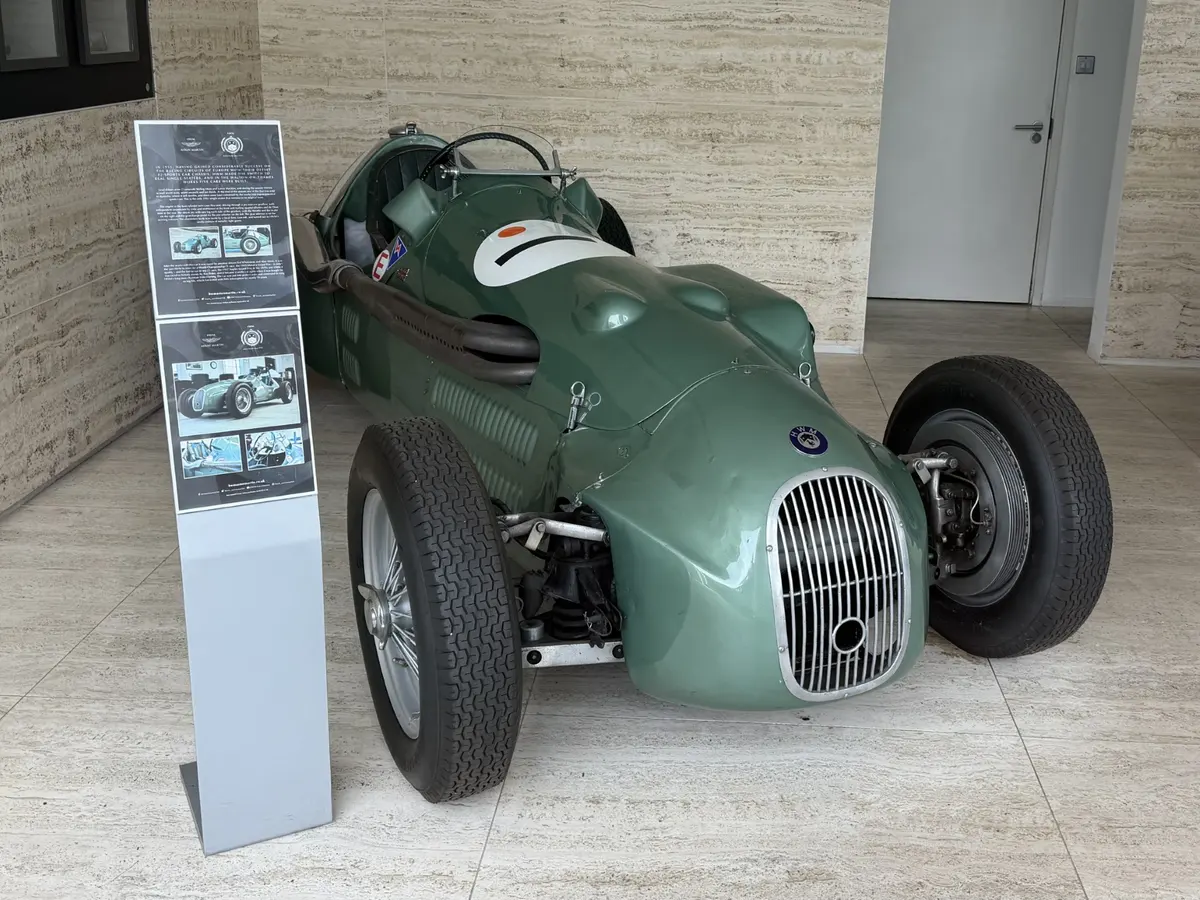
Hersham and Walton Motors
HWM was founded in 1938 by John Heath, an engineer and accomplished racing driver, and was joined in 1946 by George Abecassis, another serious racing talent, who by HWM’s own account began racing with Heath that year (Caterham Cars, 2026a; HWM, 2026; HWM, n.d.). What began as a garage and dealership business quickly grew a second identity as a racing car constructor, competing in Formula One and Formula Two as well as sports car racing through the early 1950s, an unusually ambitious sideline for a firm rooted in a Surrey car dealership.
Building their own racing cars
HWM built and campaigned its own single-seater racing cars under the HWM name through the early 1950s, competing at Grand Prix level against factory teams with vastly larger budgets. The team scored a genuine landmark early on: Johnny Claes won the Grand Prix des Frontières at Chimay in an HWM, the first post-war Grand Prix victory for a British-built car, a result that gave the small Walton-based team a real claim to a place in British motor racing history. Both HWM and Caterham describe the firm as the first British team to take a Grand Prix victory after the war, and HWM’s own history traces the progression from the HW-Alta to a full team of cars built for the 1950 Formula Two season (Caterham Cars, 2026a; HWM, 2026; HWM, n.d.). Caterham’s account of the 1951 HWM-Alta season records seven wins, seven seconds and ten thirds in international events (Caterham Cars, 2026a).
Stirling Moss’s World Championship debut
HWM’s best-known contribution to motor racing history is the driver it gave a start to rather than any single race result. Stirling Moss, then still establishing himself after strong performances in Formula Three, joined HWM’s Formula Two team in 1950 and raced its cars in non-championship events that season, finishing third at the Bari Grand Prix. It was in an HWM-Alta that he made his Formula One World Championship debut, at the 1951 Swiss Grand Prix, finishing eighth, two laps down, and first in the Formula Two class (Hughes, 2020). Moss went on to race for the team for close to two years before moving on to the career that would make him one of the most celebrated drivers in the sport’s history, and HWM’s role as the team that gave him his start remains one of the most significant footnotes in British motor racing. Caterham’s account of the 1951 HWM-Alta names Moss among its drivers, and HWM’s own history lists him among the drivers who took the cars to success in Formula One in the early 1950s (Caterham Cars, 2026a; HWM, n.d.).
HWM today
HWM’s racing ambitions did not last as long as its dealership business. The firm has represented Aston Martin since 1951, and that side of the business has long outlived the works racing team; Aston Martin’s own dealer listing describes HWM as the oldest Aston Martin dealership in the world, still trading under the same name from the same corner of Walton more than seven decades later. It is a rare example of a business that has genuinely spanned Walton’s entire postwar motoring history, from Grand Prix ambition to a settled, long-running dealership. HWM makes the continuity explicit, describing its Grand Prix cars as hand-built in the same Walton-on-Thames workshop it operates from today (HWM, 2026).
A racing legacy revived: the Caterham Seven HWM Edition
HWM’s motor-racing history gained an unexpected new chapter on 9 March 2026, when HWM and Caterham Cars announced the Caterham Seven HWM Edition, a limited-production model drawn from the 1951 HWM-Alta Grand Prix car. The collaboration grew out of a more recent commercial relationship. Caterham took HWM into its UK retailer network in 2023, covering the South East from Walton-on-Thames and beginning sales that September, which brought the Walton business back into direct association with lightweight British sports and racing cars (Caterham Cars, 2023; Caterham Cars, 2026a).
Rather than applying historic badges to a standard car, the two firms worked details from HWM’s early-1950s competition machines into the specification. The HWM Edition is based on the Caterham Seven 420 and uses that car’s naturally aspirated 2.0-litre Ford Duratec engine, producing 210 bhp through a five-speed manual gearbox. Nineteen examples were announced for the UK market (Caterham Cars, 2026a; HWM, 2026).
The colour is the most direct link back to Walton. HWM Green, the standard finish, was scanned from the 1951 HWM-Alta itself. The other references include HWM-Alta-inspired side panel louvres, an HWM-inspired vertical bar grille, suspension wishbones, anti-roll bar and headlight brackets finished in Retro Grey, a bespoke HWM nosecone badge, and a numbered dashboard plaque marking each car as one of the 19 (Caterham Cars, 2026a; Caterham Cars, 2026b; HWM, 2026).
Both companies framed the project in local terms. Trevor Steel of Caterham said the car “pays tribute to Walton-on-Thames’ rich racing heritage”, while HWM’s chief executive Guy Jenner described the collaboration as “a unique opportunity to tell the story of how a small outfit from Walton-on-Thames took on the greatest teams in European grand prix racing” (Caterham Cars, 2026a).
Jenner walks around the finished car in HWM’s own unveiling film, published on the day of the announcement.
Seventy-five years after the 1951 season, the HWM name was back on a newly built British performance car. It is an unusual link between the firm’s competition past and the business that still trades from the same corner of Walton, and a sign that the racing side of the story established by George Abecassis and John Heath still forms part of the company’s identity (HWM, 2026).
HWM in Walton’s townscape
HWM’s place in the town’s identity was recognised in a different form during the same year, 2026. Surrey County Council commissioned the illustrator and mural artist Nathan Evans to paint a large public artwork on the wall of Walton Library facing Hepworth Way, working with Elmbridge Borough Council and Love Walton BID. Before the design was settled, residents, businesses and community groups were invited to contribute ideas, through a public survey and through engagement sessions that included workshops with local colleges and visits to community venues, so that the finished work would reflect the town as local people described it (Elmbridge Borough Council, 2026; Evans, 2026).
The result, Walton Life, gathers a good deal of the town’s history onto a single wall. Evans lists riverside life and wildlife among its themes, alongside Walton Bridge, Ashley House, the Cecil Hepworth Playhouse, the Old Manor House, St Mary’s Church, Mount Felix, the films made at Walton’s studios and HWM’s racing team (Evans, 2026).
HWM appears as a green single-seater racing car. Its inclusion matters because the design was not simply one artist’s view of Walton. The subjects came out of the community engagement sessions, combined with Evans’s own research into the town and its history (Evans, 2026).
It is a fitting modern footnote to the HWM story. A racing operation that began in a local motor business and carried Walton’s name onto European circuits in the years after the Second World War has become sufficiently embedded in the town’s history to appear, generations later, in a piece of public art meant to represent Walton itself.
Sources
- Aston Martin (n.d.) 'Aston Martin Walton-on-Thames'. Available at: https://www.astonmartin.com/en-gb/dealers/aston-martin-walton-on-thames ↗ (Accessed: 3 September 2026).
- HWM (n.d.) 'Our History'. Available at: https://www.hwm.co.uk/about-us/our-history/ ↗ (Accessed: 3 September 2026).
- Caterham Cars (2023) 'Caterham welcomes HWM to UK retailer network', 30 June. Available at: https://caterhamcars.com/en/news/caterham-welcomes-hwm-to-uk-retailer-network ↗ (Accessed: 2 September 2026).
- Caterham Cars (2026a) 'Caterham unveils limited-edition Seven HWM Edition', 9 March. Available at: https://caterhamcars.com/en/news/caterham-unveils-limited-edition-seven-hwm-edition ↗ (Accessed: 2 September 2026).
- Caterham Cars (2026b) 'New HWM Caterham Seven Special'. Available at: https://caterhamcars.com/en/find-buy/new-hwm-caterham-seven-special ↗ (Accessed: 2 September 2026).
- Elmbridge Borough Council (2026) 'Help shape Walton's new public mural', 2 March. Available at: https://www.elmbridge.gov.uk/news/2026/help-shape-waltons-new-public-mural ↗ (Accessed: 2 September 2026).
- Evans, N. (2026) 'Walton Life', Nathan Evans Illustration, March. Available at: https://n-evans.com/projects/walton-life/ ↗ (Accessed: 2 September 2026).
- HWM (2026) 'Caterham Seven HWM Edition: A Racing Legacy Reimagined'. Available at: https://www.hwm.co.uk/new-cars/hwmcaterhamspecial/ ↗ (Accessed: 2 September 2026).
- HWM Caterham (2026a) 'HWM Caterham Special: a racing legacy reimagined, 09.03.26', YouTube, 7 March. Available at: https://www.youtube.com/watch?v=NVqfxv8cl5I ↗ (Accessed: 2 September 2026).
- HWM Caterham (2026b) 'HWM Caterham Special: the full unveil, a walk around with Guy and Oliver', YouTube, 9 March. Available at: https://www.youtube.com/watch?v=OLa-dCfgNMc ↗ (Accessed: 3 September 2026).
- Wikipedia (n.d.) 'Hersham and Walton Motors'. Available at: https://en.wikipedia.org/wiki/Hersham_and_Walton_Motors ↗ (Accessed: 2 July 2026).
- Hughes, M. (2020) 'Hints of future glory in Stirling Moss's first world championship grand prix', Motor Sport, 13 April. Available at: https://www.motorsportmagazine.com/articles/single-seaters/f1/mph-hints-of-future-glory-in-stirling-mosss-first-world-championship-grand-prix/ ↗ (Accessed: 14 September 2026).