
Two breweries once made beer in the heart of Walton-on-Thames. Pub deeds and property sales trace the brewers who supplied the town, and the businesses that outlasted them.
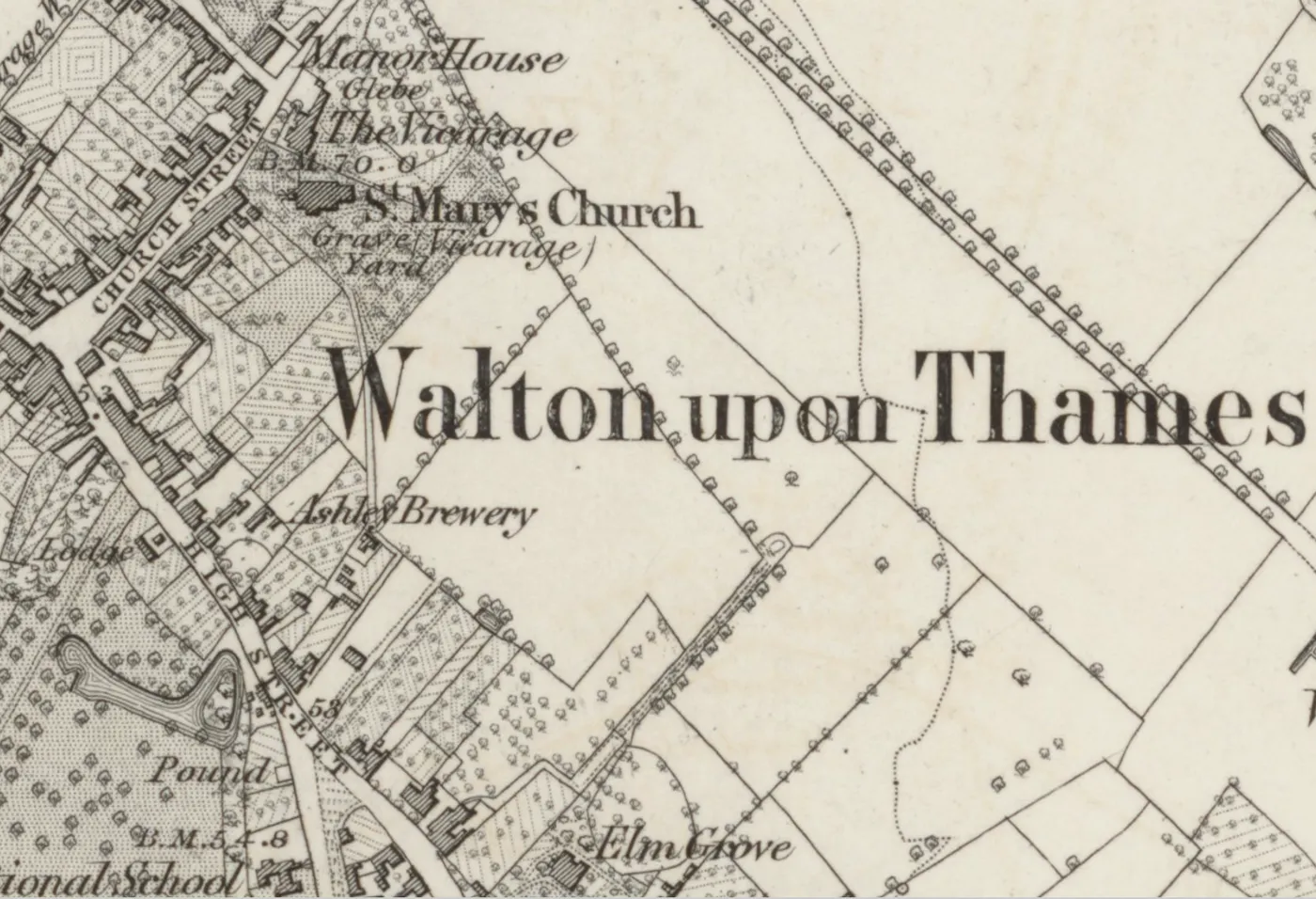
In nineteenth-century Walton, brewing was a town-centre trade. The Star Brewery stood on the east side of Bridge Street; Ashley Brewery operated a short walk away on the east side of the High Street (Tarplee, 1998, p. 44).
By around 1900, both breweries had stopped brewing. Ashley’s buildings were demolished around 1900. The Star remained in use as a depot before most of its buildings were pulled down in the 1920s. Much of their history survives in accounts of property transactions and the pubs their owners bought and leased (Martin, 1999; Tarplee, 1998, p. 44).
Those records reach back beyond the Victorian breweries to an earlier generation of Walton brewers. The histories of the Plough and the Crown provide a starting point (Martin, 1999).

The brewers behind the pub doors
One of those earlier brewers was William Brooker. When he died around 1778, his interests included the Plough in Ashley Road and the Crown, which stood at the junction of Church Street and the High Street. His will entrusted these properties to a maltster, who prepared grain for brewing, and a coachmaker. Their instructions differed: the Plough was to be sold, while the Crown was held for his widow (Martin, 1999).
The Plough’s buyer in 1779 was another local brewer, Thomas Cooper. In 1782, Brooker’s trustees leased the Crown to Cooper; the Coopers subsequently bought it in 1799. Long before the Victorian breweries, Walton already had brewers buying and leasing the places where its inhabitants drank (Martin, 1999).
The Cooper name recurs across the district. Thomas Cooper bought the King’s Arms in Weybridge in 1789. James Cooper took a lease of Walton’s Castle in 1791. George Cooper owned the Swan during the unsettled years between 1819 and 1825, when its innkeepers changed annually. At the Weir, originally called the New Inn, a building was leased to James Cooper in 1818 (Martin, 1999).
Owning or leasing an inn did not necessarily mean running it. At the Castle, the Cobbett family continued as innkeepers after James Cooper took the lease (Martin, 1999).
The Star Brewery in Bridge Street
Peter Tarplee’s industrial history places the Star Brewery on the east side of Bridge Street and records George Cooper running it by the early nineteenth century (Tarplee, 1998, p. 44).
An attempted property sale in 1847 offers a closer look at the setting. On 29 June, the estate of the Reverend Thorpe William Fowke offered several Walton properties at auction in London. One lot contained a brewery and malt-house in Bridge Street. Another was the White Hart in Church Street, with a garden extending towards the brewery property (Martin, 1999).
Both were leased to George Cooper, who was described as wishing to retire. The White Hart had a parlour, bar, tap room, spirit room and cellars, as well as a butcher’s shop and stabling for eight horses (Martin, 1999).
Neither lot reached an acceptable price, and both remained with the vendors. In 1851, the Fowke family sold the brewery and the White Hart to Jacob Wells, a Weybridge farmer (Martin, 1999).
The distinction between landlord and brewer matters here. Cooper had run the brewery as a tenant: the sale of its premises was not necessarily a sale of his business.
Tarplee records the brewery passing from Cooper to Alex Shipley in 1855, and from Shipley to Jason Gurney in 1866. Gurney also held interests in local pubs. In 1887, he obtained a 21-year lease of the Anglers from John Trotter (Martin, 1999; Tarplee, 1998, p. 44).
Brandon’s Putney Brewery took over in the 1890s. The Brewery History Society records Brandon’s Brewery Ltd being registered in July 1896 to acquire Jason Gurney’s Star Brewery, although the accounts differ on the precise date (Brewery History Society, n.d.; Hughes, 2003, p. 12; Tarplee, 1998, p. 44).
According to Tarplee, brewing stopped when Brandon’s took over. The premises remained useful to the new owners as a depot. Most of the buildings were demolished in the 1920s (Tarplee, 1998, p. 44).
The business relationships survived longer. Trotter sold the Anglers’ freehold to Brandon’s in 1897. Brandon’s itself was acquired by Mann, Crossman & Paulin in 1920. The Anglers’ ownership traces the passage from a Walton brewer to larger brewing concerns (Brewery History Society, n.d.; Martin, 1999).
Ashley Brewery: beer from the High Street
Ashley Brewery has left a thinner published record. Tarplee places its foundation in the 1850s, under George Tiley, on the east side of the High Street. William Pope bought it in 1876, followed by William Clark in 1885 (Tarplee, 1998, p. 44).
Ashley’s ending is harder to pin down. Tarplee states that brewing ceased towards the end of the nineteenth century and that the buildings were demolished around 1900. He does not identify a precise final brewing date or explain the closure (Tarplee, 1998, p. 44).
When a brewery stopped being a brewery
The Star’s closure illustrates a change that was also taking place elsewhere in the district: brewing premises could lose their original function while remaining useful to the beer trade.
At Ditton, Watney, Combe, Reid & Co continued brewing after acquiring the business in 1906, then converted the buildings into a bottling store in 1914. At Cobham, the brewery closed following the acquisition of Cobham United Breweries in 1922, a transaction that included 33 public houses (Tarplee, 1998, p. 44).
The Star’s earlier conversion to a depot belongs to this pattern of acquisition and reuse. Ashley’s closure cannot yet be explained in the same way. Nor is its final brewing date precise enough to establish which of Walton’s two breweries lasted longest (Tarplee, 1998, p. 44).
The pubs tell a more continuous story. A brewery could close while the inns associated with it passed to new owners and continued serving beer. The histories of the Anglers, the Crown and the Plough preserve something of that earlier trade, recording the brewers who once owned or leased them (Martin, 1999; Tarplee, 1998, p. 44).
A new chapter beside the Engine River
Today, Engine River Brew Co makes beer in small batches at its nano-brewery on the banks of the Engine River, on the fields of the Old Dairy farm in Weybridge (Engine River Brew Co, n.d.).
Sources
- Brewery History Society (n.d.) 'Brandon's Brewery Ltd'. Available at: https://breweryhistory.com/wiki/index.php/Brandon%27s_Brewery_Ltd ↗ (Accessed: 15 September 2026).
- Engine River Brew Co (n.d.) 'Engine River Brew Co'. Available at: https://engineriverbrew.co.uk/ ↗ (Accessed: 15 September 2026).
- Hughes, W. (2003) Walton-on-Thames (Images of England series). Tempus Publishing.
- Martin, A. G. (1999) Inns & Taverns of Walton & Weybridge: Some Notes on Their History (M. E. Blackman, Ed.; 2nd ed.; Paper No. 12). Walton & Weybridge Local History Society.
- Ordnance Survey (1871) Surrey Sheet XII [Map, Six-inch England and Wales, 1842-1952; surveyed 1866 to 1868; map 61 x 92 cm]. National Library of Scotland. Available at: https://maps.nls.uk/view/266664424#zoom=6.1&lat=10138&lon=2427&layers=BT ↗ (Accessed: 15 September 2026).
- Ordnance Survey (1896) Middlesex Sheet XXV.13 [Map, 25 inch to the mile, 2nd edition; revised 1894]. National Library of Scotland. Available at: https://maps.nls.uk/view/103658642 ↗ (Accessed: 18 September 2026).
- Ordnance Survey (1914) Surrey Sheet XII.5 [Map, 25 inch to the mile; revised 1912]. National Library of Scotland. Available at: https://maps.nls.uk/view/103314202 ↗ (Accessed: 18 September 2026).
- OpenStreetMap contributors (n.d.) 'OpenStreetMap'. Available at: https://www.openstreetmap.org/copyright ↗ (Accessed: 18 September 2026).
- Tarplee, P. (1998) A Guide to the Industrial History of the Borough of Elmbridge. Surrey Industrial History Group.