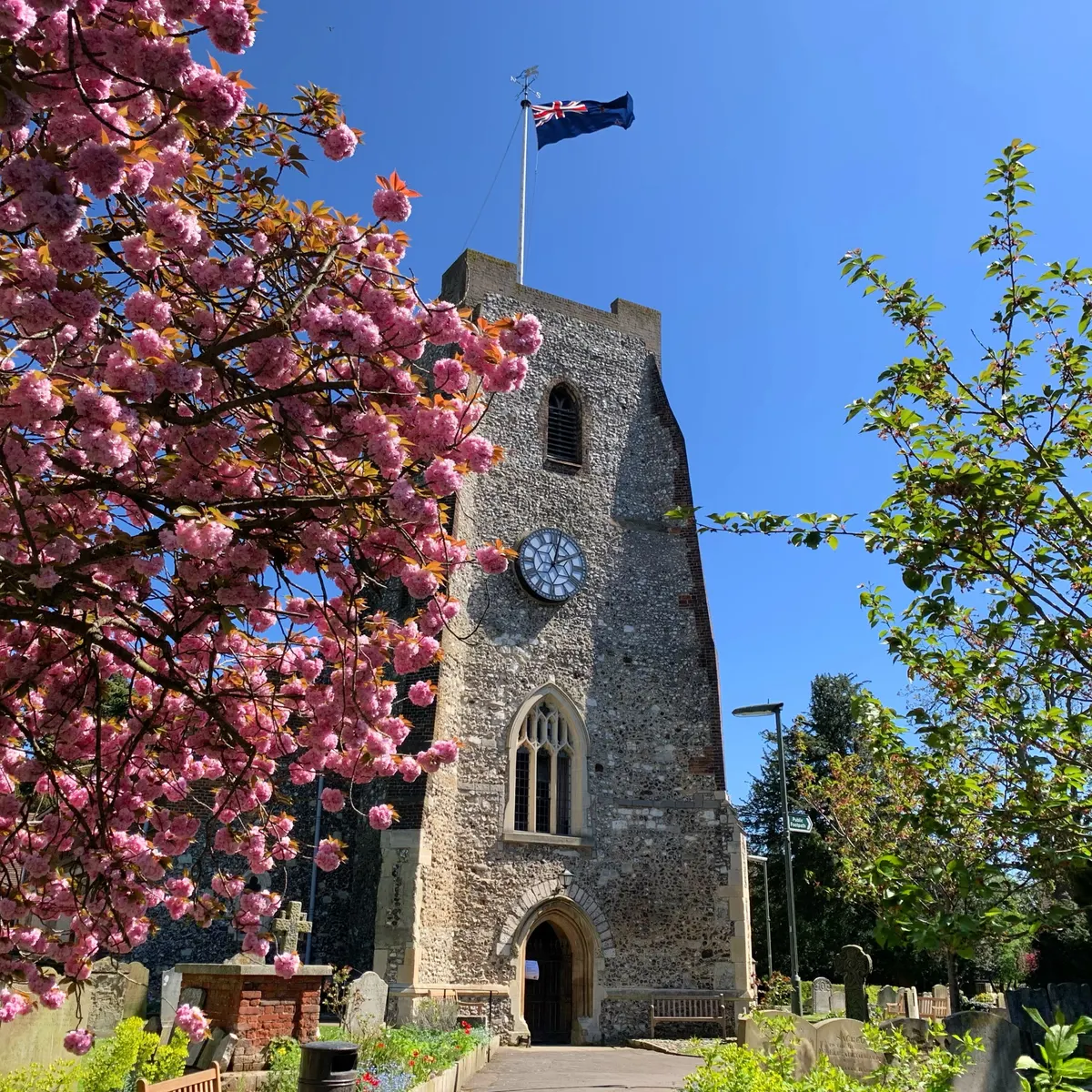
Visitors to Walton-on-Thames in April may notice something unusual flying above the town’s ancient parish church. Instead of the Union Flag or the flag of St George, St Mary’s Church flies the flag of New Zealand around Anzac Day.
For anyone unfamiliar with Walton’s history, the sight of the New Zealand flag above a medieval Surrey parish church might seem surprising. But it represents a connection stretching back more than a century, to the First World War, when thousands of wounded New Zealand soldiers were brought to Walton-on-Thames for treatment. Some never returned home. Their story explains not only the flag at St Mary’s, but also why New Zealand servicemen are buried in the churchyard, why an Anzac service is still held in Walton, and why one of the town’s principal roads is called New Zealand Avenue.
The answer in brief
St Mary’s Church flies the New Zealand flag in April in remembrance of the New Zealand servicemen and women whose lives became connected with Walton-on-Thames during the First World War.
From 1915, Mount Felix in Walton-on-Thames became a hospital for sick and wounded New Zealand servicemen, later officially named No. 2 New Zealand General Hospital. Together with the associated hospital at Oatlands Park in Weybridge, around 27,000 men were treated over the course of the war. Those who died in Walton included New Zealand servicemen buried at St Mary’s, and their memory has been marked here for more than a century. Every year, that connection is remembered around Anzac Day, 25 April, and the New Zealand flag flying at St Mary’s is one of the most visible signs of a relationship that has continued ever since.
Why were thousands of New Zealand soldiers in Walton-on-Thames?
The story begins thousands of miles from Surrey. When Britain declared war on Germany in August 1914, New Zealand, then a Dominion of the British Empire, entered the First World War too, raising the New Zealand Expeditionary Force to serve overseas, including at Gallipoli and later on the Western Front.
The fighting produced enormous numbers of wounded and sick servicemen. According to New Zealand’s Ministry for Culture and Heritage, by the end of 1915 around 3,000 sick and wounded New Zealanders were in England, either in British hospitals or at a civilian-run New Zealand hospital at Walton-on-Thames. Walton had become part of an international medical network supporting New Zealand’s armed forces.
Mount Felix becomes a New Zealand hospital
The New Zealand hospital at Mount Felix, close to the River Thames, opened on 31 July 1915, according to Radio New Zealand the first of three UK hospitals set up specifically for New Zealand’s wounded. Mount Felix was a substantial country house and estate, but wartime casualties soon required far more accommodation than the house itself could provide, and huts and tents were erected in the grounds; as demand grew further, the nearby Oatlands Park Hotel in Weybridge was also brought into use as additional hospital accommodation. In August 1916, the Walton hospital took its official name, No. 2 New Zealand General Hospital.
Funding came in large part from the New Zealand War Contingent Association, led by the New Zealand High Commissioner, Sir Thomas Mackenzie, drawing on contributions from New Zealanders living in Britain as well as support from the New Zealand government. New Zealand’s Ministry for Culture and Heritage records that approximately 27,000 men were treated at Mount Felix and the associated Oatlands Park hospital over the course of the war. Radio New Zealand reports that despite that huge number, only around 150 died, a low toll that Mackenzie himself attributed at the time to “the skill of the surgeons and physicians and the care of the nurses.”
For several years, this Surrey town became a temporary home to thousands of New Zealanders recovering from the war.
New Zealand nurses and volunteers came to Walton too
The New Zealand presence at Mount Felix wasn’t confined to wounded soldiers. New Zealand women also played an important role at the hospital, among them trained nurses and women serving with Voluntary Aid Detachments, who supported the nursing staff and undertook work ranging from kitchens to ambulance driving.
The hospital’s standing was reflected in a royal visit. New Zealand’s Ministry for Culture and Heritage dates a visit by King George V, Queen Mary and the Prince of Wales to Mount Felix to August 1915; Elmbridge Museum’s commemorative postcard of the same visit is catalogued as 1917, a discrepancy this article resolves in favour of the Ministry’s dating. For wartime Walton, New Zealand was no longer a distant country on the other side of the world; New Zealanders had become part of everyday local life.
The New Zealanders who never went home
Most patients eventually left Walton, but some died from their wounds or illnesses. New Zealand servicemen connected to the hospital were buried in St Mary’s Churchyard, the most enduring link between the parish church and New Zealand. Walton Parish’s own history of the church records that a brass memorial near the West Door commemorates those who died at Mount Felix and were buried here.
The story of exactly how that commemoration developed, an embroidered memorial banner carried from the church to the graveside every Anzac Day from 1920, later replaced by the permanent brass memorial that still hangs in the church, is told in full in our guide to the Walton memorial banner. What matters for the flag is simpler: St Mary’s became, and has remained, a place of remembrance for New Zealand families whose relatives died thousands of miles from home.
What is Anzac Day?
Anzac Day is commemorated annually on 25 April. ANZAC stands for the Australian and New Zealand Army Corps, and the date marks the landing of Australian and New Zealand forces on the Gallipoli peninsula on 25 April 1915, during the First World War. The campaign was costly and ultimately unsuccessful, but 25 April became one of the most important national days of remembrance in both New Zealand and Australia, and today Anzac Day commemorates more broadly those who served and died in wars, conflicts and peacekeeping operations.
Although the principal commemorations naturally take place in Australia and New Zealand, services are also held overseas at places with a real historical connection to their armed forces. Walton-on-Thames is one of them.
Anzac Day in Walton-on-Thames today
More than a century after the First World War, St Mary’s continues to hold an annual Anzac commemoration. Walton Parish describes the New Zealanders’ memory as honoured each year “at the annual Civic Service on Anzac Day in the presence of the New Zealand High Commissioner.”
The connection remains recognised officially by New Zealand. The New Zealand Ministry of Foreign Affairs and Trade’s official programme of Anzac Day events across the United Kingdom for 2026 lists a service at St Mary’s Church, Church Street, Walton-on-Thames, on Sunday 26 April 2026 at 6.30pm, alongside major commemorations in London and services at some two dozen other locations around the country. The Commonwealth War Graves Commission separately lists an annual Anzac Day service at the New Zealand memorial in St Mary’s Churchyard. The remembrance survives, in other words, not as local folklore but as a continuing relationship between Walton-on-Thames and New Zealand, marked officially on both sides. As with any listed event date, it’s worth checking St Mary’s or the New Zealand High Commission directly closer to the time.
So why does St Mary’s fly the New Zealand flag?
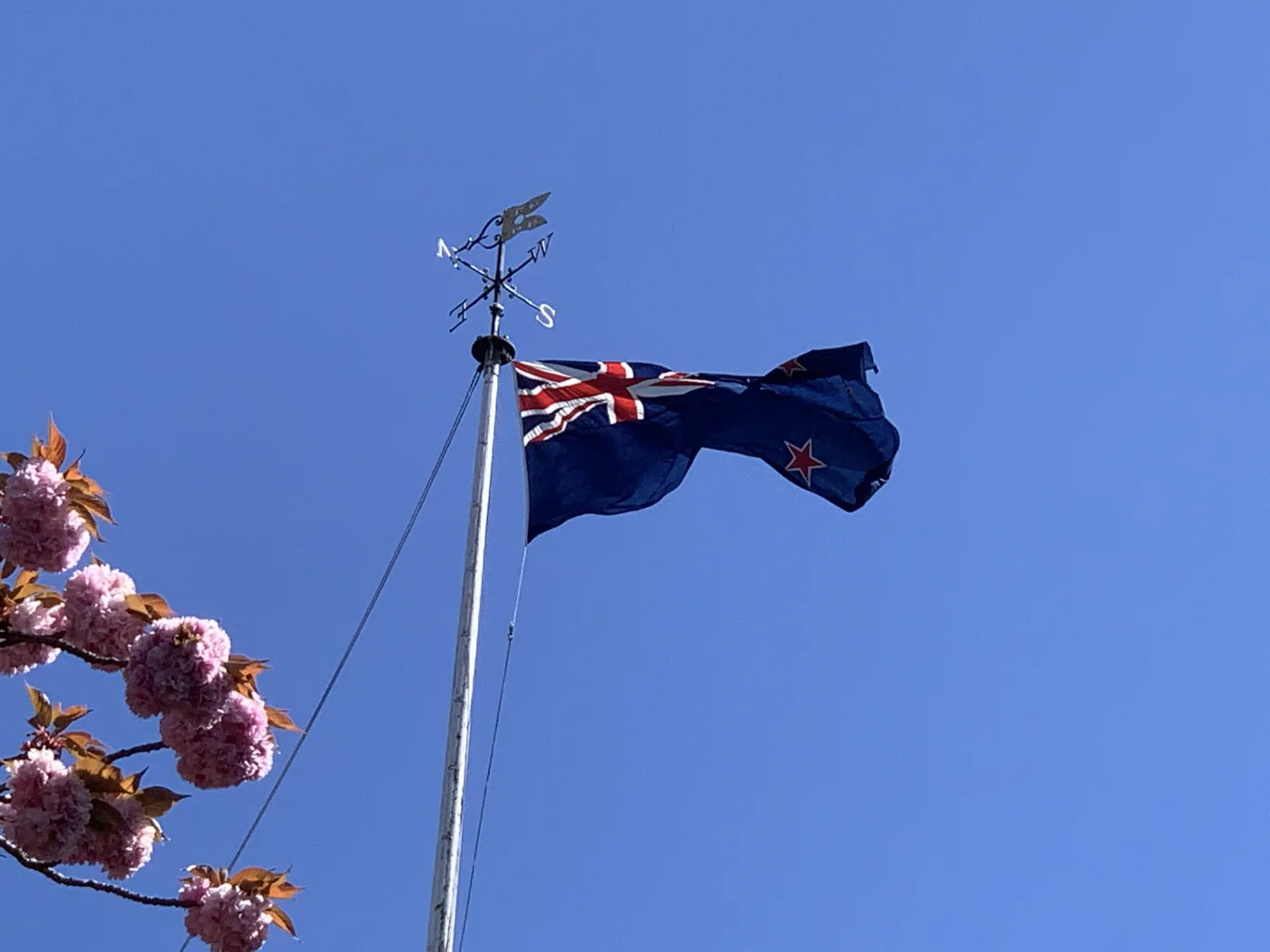
The flag is a simple expression of a much larger story. It remembers the thousands of New Zealanders who came to Walton during the First World War, the doctors, nurses, volunteers and local people who cared for them, and, above all, those who died here and whose resting place became a Surrey churchyard rather than their homeland on the other side of the world.
The precise date on which the modern custom of flying the New Zealand flag from St Mary’s began hasn’t been established from the sources reviewed for this article. What is firmly documented is a tradition of Anzac Day remembrance at St Mary’s extending back to at least 1920, when the Walton memorial banner was first carried from the church to the New Zealand graves each year. The flag flying over St Mary’s each April continues that century-old act of remembrance.
Walton’s other reminders of New Zealand
The church isn’t the only surviving reminder. Perhaps the most obvious is New Zealand Avenue, one of the principal roads through Walton town centre, running from the site of the former hospital and named as a tribute to that connection. Radio New Zealand also records a kowhai tree, a species native to New Zealand, planted near the old hospital site with a commemorative plaque, a gift from the New Zealand High Commission in 1970.
Mount Felix itself has largely disappeared, but its history has also been preserved through the Mount Felix Tapestry, a community embroidery project telling the story of the New Zealand hospital in thread. For the fuller history of the hospital itself, see our guide to Mount Felix, and for St Mary’s Church more generally. Together, the graves, memorials, road name, kowhai tree, tapestry, annual Anzac service and New Zealand flag form an unusual concentration of New Zealand remembrance in an English town.
Frequently asked questions
Why does St Mary’s Church in Walton-on-Thames fly the New Zealand flag?
In remembrance of the New Zealand servicemen treated at the First World War hospital at Mount Felix, and those who died in Walton and are buried at St Mary’s.
When was the New Zealand hospital at Mount Felix open?
It opened on 31 July 1915 and was officially named No. 2 New Zealand General Hospital from August 1916. Together with the associated hospital at Oatlands Park, around 27,000 men were treated there during the war.
Are New Zealand soldiers buried in Walton-on-Thames?
Yes. New Zealand servicemen connected to the Mount Felix hospital who died are buried in St Mary’s Churchyard, commemorated today by a brass memorial inside the church.
Is there still an Anzac Day service in Walton-on-Thames?
Yes. St Mary’s Church holds an annual civic Anzac Day service, attended by the New Zealand High Commissioner, and the service is included in the New Zealand Ministry of Foreign Affairs and Trade’s official Anzac Day programme for the UK.
Why is there a road called New Zealand Avenue in Walton-on-Thames?
It’s named for the town’s First World War connection to New Zealand, one of several lasting local reminders alongside St Mary’s memorials and its annual Anzac Day service.
Sources
- Manatū Taonga, Ministry for Culture and Heritage (n.d.) 'New Zealand Army Nursing Service in the First World War'. Available at: https://nzhistory.govt.nz/war/first-world-war-nurses ↗ (Accessed: 28 July 2026).
- Manatū Taonga, Ministry for Culture and Heritage (n.d.) 'Walton-on-Thames NZ General Hospital Roll of Honour'. Available at: https://nzhistory.govt.nz/media/photo/walton-thames-nz-general-hospital-roll-honour ↗ (Accessed: 28 July 2026).
- Elmbridge Museum (n.d.) 'The Mount Felix War Hospital'. Available at: https://elmbridgemuseum.org.uk/online-exhibitions/the-mount-felix-war-hospital/ ↗ (Accessed: 28 July 2026).
- Walton Parish (n.d.) 'Tour of St Mary's Church: New Zealand Links'. Available at: https://waltonparish.org.uk/tour/ ↗ (Accessed: 28 July 2026).
- New Zealand Ministry of Foreign Affairs and Trade (2026) 'Anzac Day 2026: United Kingdom'. Available at: https://www.mfat.govt.nz/en/countries-and-regions/europe/united-kingdom/new-zealand-high-commission/anzac-day-london-2026 ↗ (Accessed: 28 July 2026).
- Commonwealth War Graves Commission (n.d.) 'Annual ANZAC Day Service, Walton-on-Thames'. Available at: https://www.cwgc.org/visit-us/events/annual-anzac-day-service-walton-on-thames/ ↗ (Accessed: 28 July 2026).
- Radio New Zealand (2018) 'The Mount Felix Tapestry: Kiwi soldiers in Walton-on-Thames'. Available at: https://www.rnz.co.nz/national/programmes/summer-days/audio/2018628770/the-mount-felix-tapestry-kiwi-soldiers-in-walton-on-thames ↗ (Accessed: 28 July 2026).